Extend the ritual
Three plants that have walked with cacao since Mesoamerica.
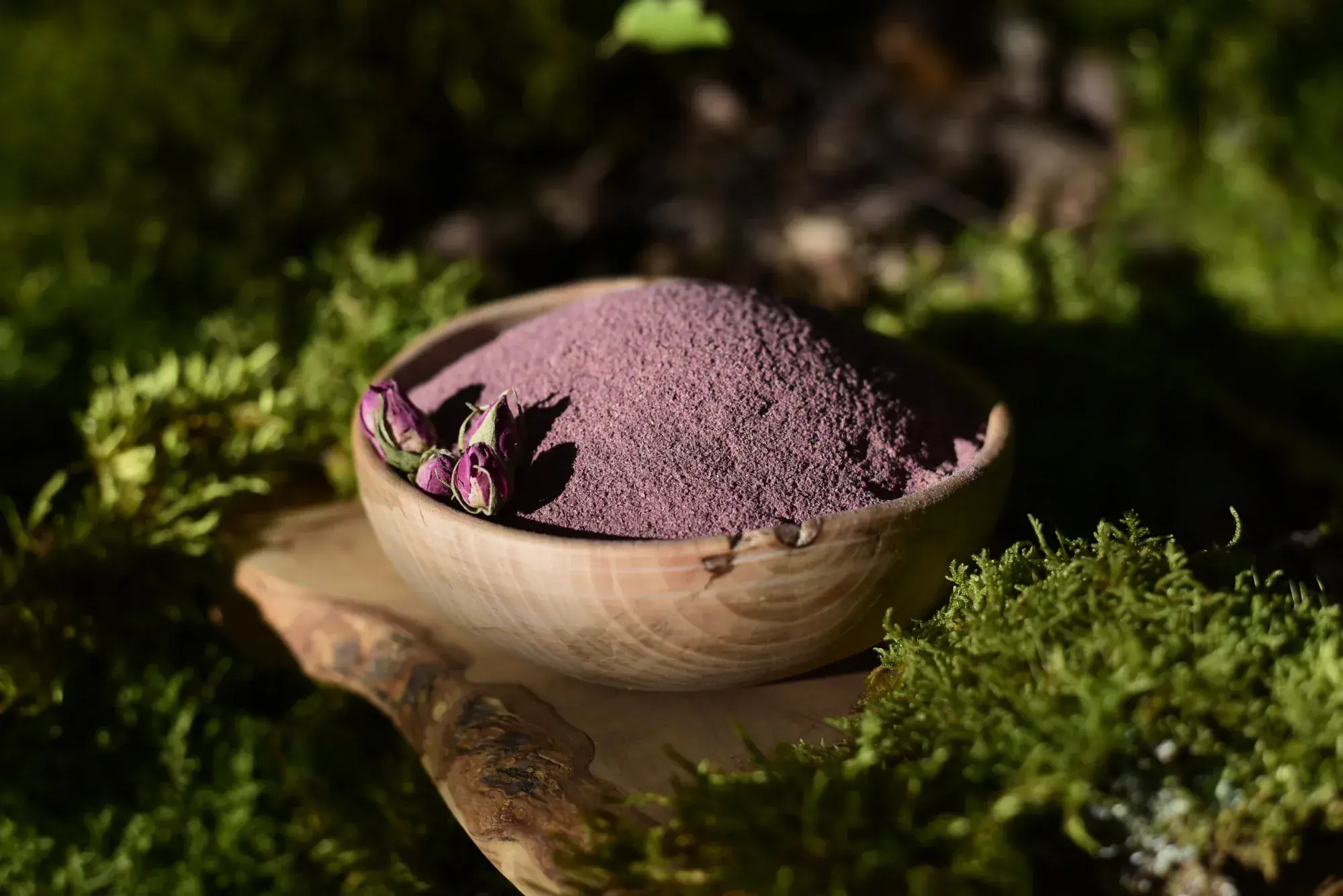
Roses
Petal powder — softens the heart, opens the petal after cacao.
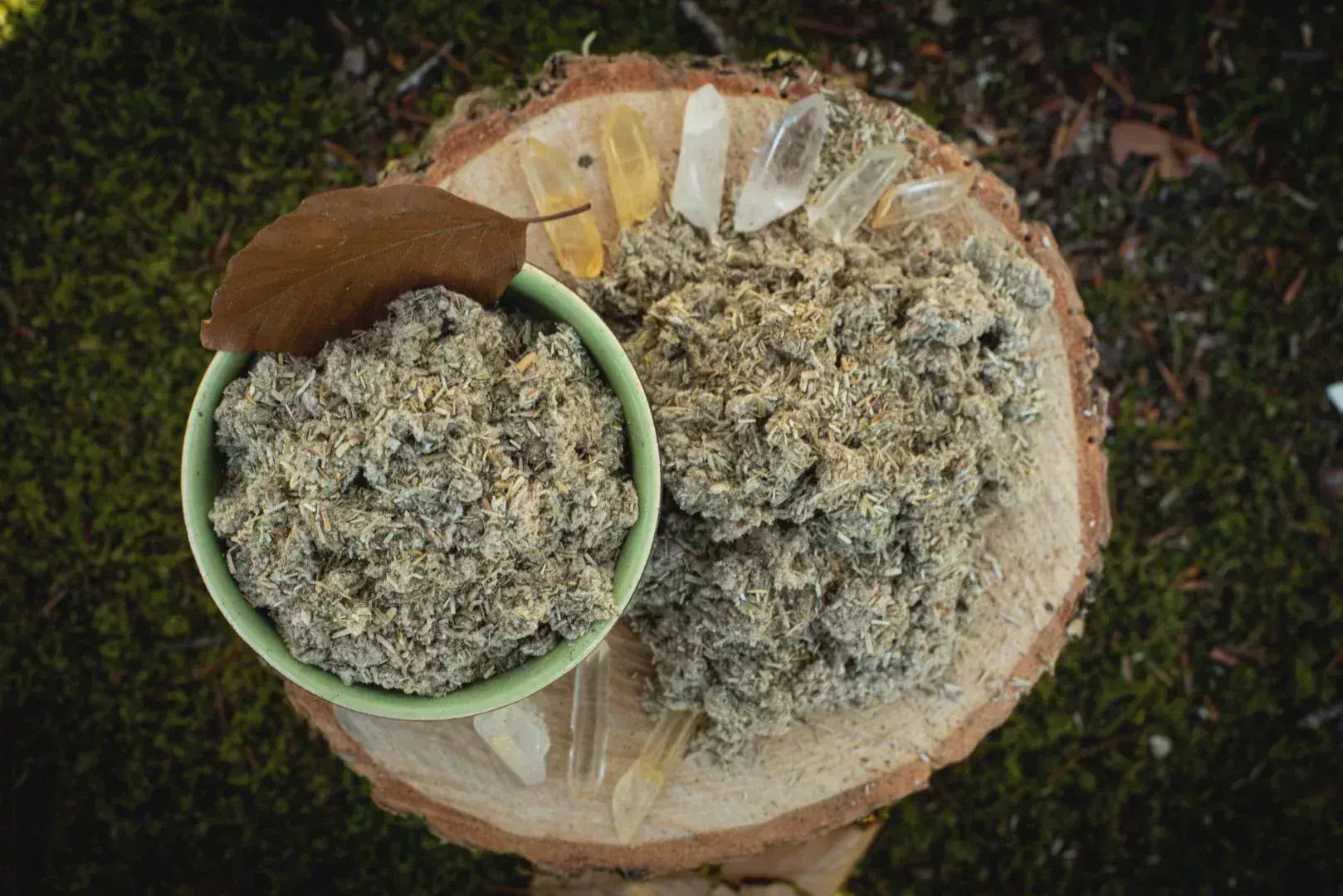
Imphepho
Ceremonial resin — purifies the circle's space before opening.
Read it through your world
The whole page is read through this lens.
✦ Ceremonial Cacao · in one breath ✦
A slow warmth that descends from the sternum to the belly and reopens the chest — the body remembers it is a living parliament, and the circle gathers.
⊹ The path of the plant
⊹ Community voices
What the community murmurs.
Average · 11 reviews
Breakdown
Really beautiful smell. Very chocolaty of course but also a floral smell which I was surprised. It’s hard to get 100% cacao seed oil. Happy I found somewhere. Thank you ☺️
Indianna
Ritual · 30 January 2026
Ask the Forest about Ceremonial Cacao
408 books digested, 97,512 indexed passages. She answers on lineages, synergies, cautions, ritual variations.
⊹ FREQUENT QUESTIONS ⊹
We answer.
What exactly is ceremonial cacao?
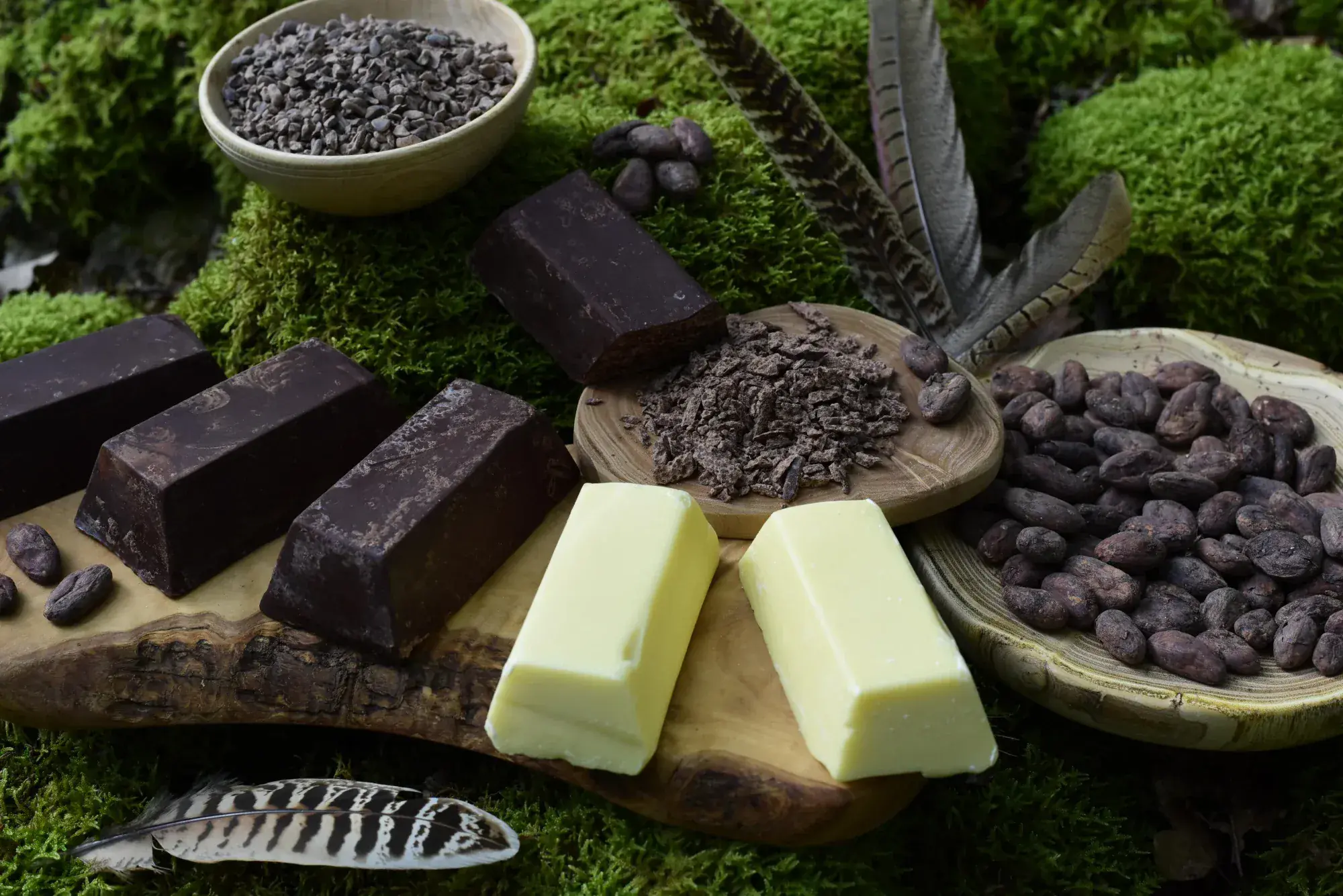
Ceremonial cacao is 100% pure raw cacao paste (Theobroma cacao), obtained by simple grinding of the beans, without high-temperature roasting — which distinguishes her from industrial chocolate. At INFUSE, she comes from Madagascar. We grate her and whisk her in warm water (never boiling, under 60°C) for a bitter, warm drink, sipped slowly, often in circle.
Is the cacao ceremony a real Maya tradition?
No, not the "cacao ceremony" as known in the West: it is a modern format born around 2003. The ritual use of cacao in Mesoamerica, however, is real and about four thousand years old (Olmecs, Mayas, Aztecs). INFUSE honours this ancient relation without pretending to reproduce an uninterrupted Maya ceremony that does not exist.
How much ceremonial cacao per cup?
In circle, tradition uses a generous dose — typically around 30 g of paste per cup. Daily, in place of coffee, 20 to 30 g is enough. Grate the tablet, whisk in simmering water under 60°C until frothy. Starting lighter is wise for a first time.
Why non-boiling water for raw cacao?
Because excessive heat damages the raw bean. Raw cacao keeps the bean as close as possible to her natural state; above about 60°C, the earthy and creamy profile that makes her quality is lost. Heat the water, let it simmer, and stay under 60°C — never boiling.
What's the difference between ceremonial cacao and hot chocolate?
Hot chocolate contains sugar, milk and cacao often roasted at high temperature. Ceremonial cacao is 100% pure raw cacao paste — naturally composed of about 55% cacao butter — without added sugar or milk. It is the raw bitterness of the bean, not a confection.
Which plants pair with ceremonial cacao?
Historically grounded pairings are vanilla and chilli, already present in the Mesoamerican drink. Mexican Tarragon (Yauthli) is traditionally linked to the Aztec recipe of Xocoatl. INFUSE also offers rose, imphepho for the circle's space, and bobinsana in a cross-tradition heart accord.
Is ceremonial cacao dangerous? Is there a risk of overdose?
To this day, no case of cacao overdose is known in ethnobotanical literature. Cacao does however contain natural stimulants: moderation during pregnancy, caution in case of sensitivity (heart rate, sleep), and she is toxic to dogs and cats — to keep out of their reach.
Where can I buy raw ceremonial cacao?
INFUSE offers 100% pure raw ceremonial cacao from Madagascar — in tablet (~8 sticks, 1080 g) and as pure essential oil — with shipping to France and the European Union. Traceability (named origin, raw processing) is what distinguishes an honest cacao from a marketing story.
⊹ Chapter · Questions ⊹
Ask, answer, share.
One question, one answer — sometimes several voices. The community answers first; INFUSE steps in when it should.
Nobody has opened a thread yet about this plant. You can be the one — a real question, a use, a doubt, a detail.
Anonymous if you prefer.
In depthbotany · phytochemistry · history
Botany
Theobroma cacao is a small tropical evergreen tree that reaches some fifteen metres and can live around sixty years. It belongs to the Malvaceae family (long classified among the Sterculiaceae); the genus Theobroma holds about twenty species according to taxonomists. Cacao is grown in three main varieties: Criollo, rare and complex, Forastero, robust and dominant in world production, and Trinitario, a hybrid of the two.
Its most striking signature is cauliflory: flowers and fruit are born directly on the trunk and the large branches, never at the tips of the twigs. Very few tropical trees carry this trait. It is a shade plant that does not tolerate direct sun; it grows only in the tropics, in zones receiving at least 130 cm of rain per year. The wild form originates in upper Amazonia, in the north-west of South America, but from prehistoric times the cultivated tree had spread through all the tropical forests of the Americas.
An Amazonian origin — the longest alliance
The common narrative makes cacao a tree of Central America. Archaeology has reversed this map. The oldest traces — theobromine residues on ceramics — come from the Mayo-Chinchipe of Ecuador, in Upper Amazonia, and are dated to around 3300 BCE, close to five thousand three hundred years ago (Zarrillo et al., Nature Ecology & Evolution, 2018). This predates Mesoamerican use by about one thousand five hundred years. Cacao was first domesticated in Amazonia, then travelled slowly northward over millennia before becoming the divine tree of the Olmecs, the Mayas and the Aztecs.
Christian Rätsch, for his part, documents a ritual relationship of about four thousand years in Central America: there cacao was venerated as food of the gods, consumed in rituals and offered to the deities. The word itself keeps this memory: kakawa among the Olmecs (Mixe-Zoque language), ka'kaw among the Mayas, cacahuatl ("bitter water") among the Aztecs, then cacao in Spanish and French. The genus name Theobroma, chosen by Linnaeus in 1753, comes from the Greek theós (god) and brôma (food).
Maya cosmology weaves the human and the bean together: the Madrid Codex shows four young gods bleeding onto cacao pods, and the Popol Vuh hangs the severed head of the Maize God on a cacao tree. Cacao and maize are twins there, at the origin of humankind. Several deities are attached to it — Ek Chuah, the merchant god and patron of cacao traders; Ix Cacao, associated with the moon and fertility; Quetzalcoatl, the Feathered Serpent who is said to have brought cacao to humans. Among the Aztecs, the bean served at once as food, stimulant, traditional medicine and currency: the anthropologist David Graeber recalls that an equivalence such as "a hundred beans for a slave" inscribes an economic violence at the very heart of the plant. It was the conquistador Hernán Cortés who brought the first beans to Europe, where a recipe from 1528 is documented.
Phytochemistry: what the bean contains
More than two hundred compounds have been identified in the bean. The pharmacological signature rests above all on the methylxanthines: theobromine dominates (1 to 2% of the weight), far ahead of caffeine (0.1 to 0.3%, against 1 to 2% in coffee). To these are added affective compounds in small quantities — phenylethylamine (PEA), anandamide (an endocannabinoid whose name derives from the Sanskrit ananda, bliss), tryptophan (precursor of serotonin) and tyrosine (precursor of dopamine).
The bean is also rich in flavonoids — epicatechin, catechin, procyanidins — and in minerals: raw cacao is one of the highest known plant sources of magnesium (on the order of 500 mg per 100 g), complemented by iron, copper, manganese and zinc.
What the studies report
The descriptions that follow report what the literature documents; they constitute neither a promise of effect nor medical advice. Theobromine acts through phosphodiesterase inhibition and a mild blockade of adenosine receptors, with a half-life (7 to 12 hours) longer than that of caffeine. Some work reports vasodilation and an increase in blood flow. Several meta-analyses published between 2010 and 2020 report, for regular consumption of unsweetened cacao, a modest lowering of systolic blood pressure (on the order of a few millimetres of mercury) and an improvement in endothelial function. Rätsch, moreover, classes cacao among the "socioplastic" psychoactives — those that alter the fabric of a group more than individual consciousness, which sheds light on why the bean has always been drunk in circle.
Raw or industrially roasted
The distinction is read in the taste and rests on chemistry. Industrial roasting, above 120°C, degrades a significant part of the heat-sensitive compounds (PEA, anandamide, certain antioxidants), while theobromine and the main flavonoids resist. Ceremonial cacao — unroasted or heated very gently — keeps the bean as close as possible to its original state: more complex, more bitter, more earthy. This is why the water is heated without being brought to a boil (under 60°C). To note: fermentation, an essential step in the appearance of aroma, raises the pulp to between 45 and 50°C — a knowledge that the Olmec farmers already mastered.
The "ceremony" of 2003 — what is verified
It is worth restating calmly, because it is rare in this market. The Mesoamerican ritual use of cacao is verified and deep: several millennia, codices, deities, a drink whisked to a froth and poured from a height between two vessels to make it rise. But the "cacao ceremony" as it circulates in the West is a modern format, born around 2003 — sincere as a contemporary practice, but without unbroken continuity with an ancient Maya ceremony. INFUSE holds both ends: honouring the real relationship, several millennia old, without selling the costume of a tradition made yesterday. The indigenous drink, moreover, was almost never cacao alone: an important ingredient of the traditional preparations was the flower of Quararibea funebris (which today gives tejate), and the blends combined maize flour, wild-bee honey, vanilla and chilli; the Old World spices — cinnamon, nutmeg, cloves, anise — only joined the recipe after the Spanish conquest, with colonial trade.
Safety notes
To this day, no case of cacao overdose is known in the ethnobotanical literature (Rätsch). Cacao does, however, contain natural stimulants: it can accelerate the heart rate and disturb sleep in sensitive people, hence the value of drinking it in the morning or early afternoon. Moderation during pregnancy and breastfeeding, where theobromine can cross the placental barrier and pass into milk. Caution in case of combination with certain antidepressants (MAOIs) or of migraines triggered by theobromine. Finally, a non-negotiable point: cacao is toxic to dogs and cats (theobromine they cannot metabolise) — to keep strictly out of their reach. This section documents a lineage and a composition, not a medical protocol; in case of doubt, consult a health professional.