⊹ To weave around
To accompany Indianmix RYO
Click a card to see why it pairs — and choose your form.

⊹ Community voices
What the community murmurs.
4.3/54 reviews, including 1 left on our Etsy shop · 3 of them average 4/5
✦ Indianmix RYO · in one breath ✦
A gentle blend of Indian herbs, nicotine-free.
Signature INFUSEIntensity · scored out of 10
| dhumapana-breath | 10/10 | |
|---|---|---|
| spiced taste | 9/10 | |
| ayurvedic-pranic | 10/10 | |
| queen plant | 9/10 | |
| three variations | 8/10 |
Register dhumapana, queen plant + vehicle + spice, three breaths · Charaka Samhita · Vrinda/Padma Purana · Vasaka, plant of the breath · Kerala-Kashmir · gulab jal
⊹ The path of the plant
⊹ FREQUENT QUESTIONS ⊹
We answer.
What is Indianmix RYO and what does it contain?
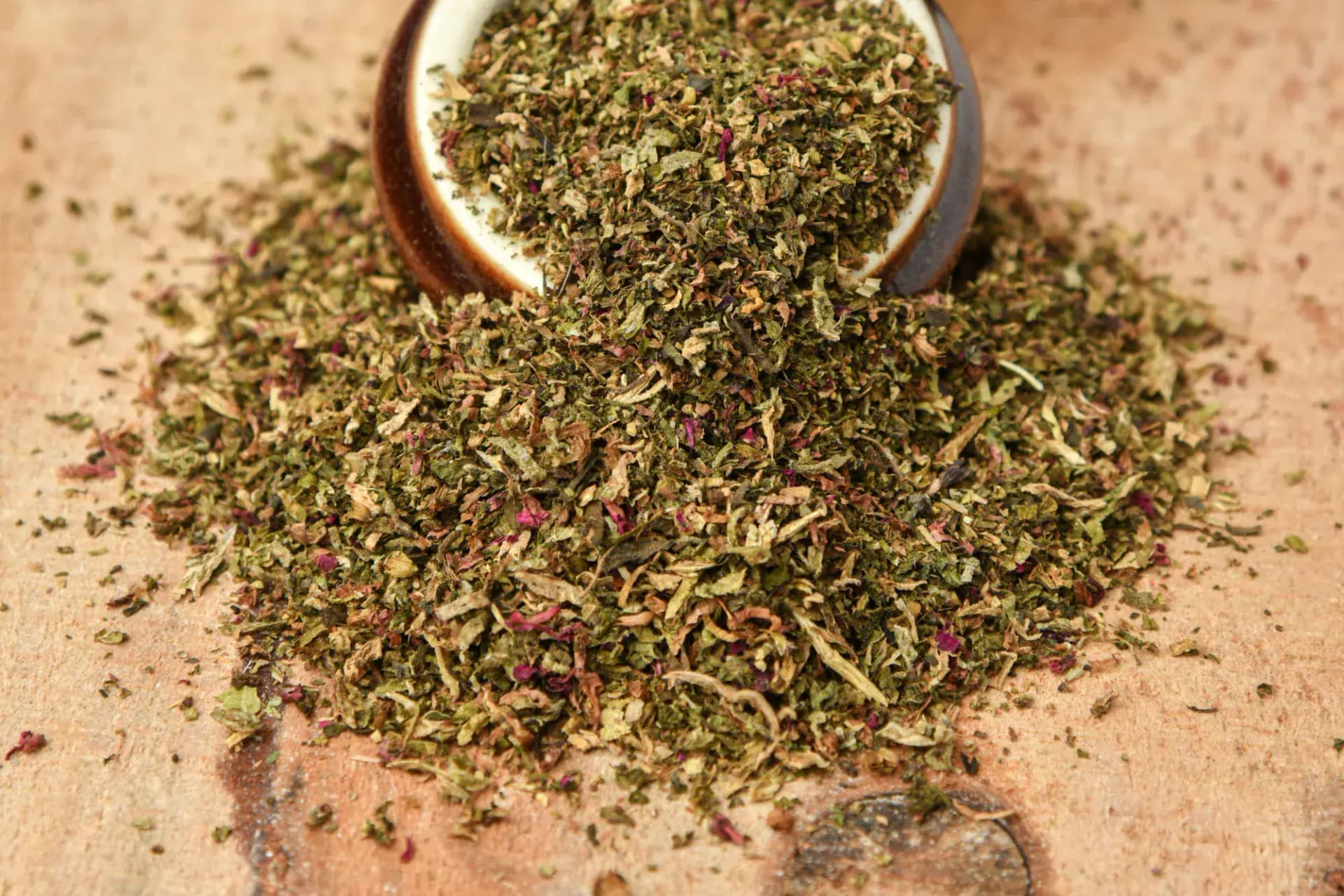
Indianmix RYO is a blend of Indian herbs to roll, without tobacco and without nicotine, inspired by the Ayurvedic practice of dhumapana. Its base brings together six plants — Ashwagandha (Withania somnifera), Tulsi (Ocimum sanctum), Clove basil (Ocimum gratissimum), Damask rose (Rosa damascena), Tea plant (Camellia sinensis), Vasaka (Adhatoda vasica). Three variations exist: Regular (the pure Ayurvedic base), Clove (with Tamala Indian bay and clove), Mint (with Himalayan wild mint).
Does Indianmix contain tobacco or nicotine?
No, Indianmix RYO is free of tobacco and nicotine. You roll it pure or mixed with tobacco, to your taste; mixed with tobacco, the smoke of course carries the tobacco's nicotine.
What is the difference between Indianmix and Herbal Mix?
Both are tobacco-free rolling blends, but drawn from two different cosmologies. Indianmix draws on the Ayurvedic pharmacopoeia of India — Tulsi, Ashwagandha, Damask rose, tea plant, Vasaka. Herbal Mix draws on European tradition — Mullein, Damiana, Mugwort, rose petals. Many mix them half-and-half to soften Indianmix or spice up Herbal Mix.
What proportions of Indianmix RYO and tobacco should I use?
To your taste. Start half and half to get to know the taste, then raise the share of herbs at your own pace, all the way to smoking it pure if that speaks to you. The Mint variant brings a crisp freshness, the Clove a spiced warmth.
Which variation should I choose — Regular, Clove or Mint?
Regular is the most neutral, the pure Ayurvedic base, ideal to start with or to blend with other herbs. Clove is lightly spiced, with Tamala Indian bay and clove — signature of South India, warm and aromatic. Mint is very minty, with Himalayan wild mint (Mentha arvensis) — fresh and lively in the mouth.
Can I infuse Indianmix instead of smoking it?
Yes, the same herbs can be infused (simmering water, 5 to 10 min) — it is also a traditional use of the Ayurvedic pharmacopoeia. The infusion does not carry the same quality as the breath; it widens the gesture to other moments of the day.
All questions
What are the risks of smoking herbs?
Any smoke — even from herbs — is a pulmonary irritant. Indianmix contains no nicotine and no industrial additives, and its combustion produces particles like any smoke. It is kept for an occasional ritual of the breath. The infusion path remains the gentlest for the airways.
Indianmix during pregnancy or breastfeeding?
During pregnancy and breastfeeding, it is better to avoid burning any herbs (including Indianmix). Several of the plants in the blend — Ashwagandha, Vasaka, Rose — have traditional uses that require professional guidance during these periods. If Ayurvedic breath calls, the infusion path framed by a healthcare professional is preferable.
⊹ Chapter · Questions ⊹
Ask, answer, share.
One question, one answer — sometimes several voices. The community answers first; INFUSE steps in when it should.
Nobody has opened a thread yet about this plant. You can be the one — a real question, a use, a doubt, a detail.
In depthbotany · phytochemistry · historyRead
Botany of a blend: six plants, two variations
Indianmix RYO is a blend of six classical Ayurvedic herbs, plus two variations that add signature notes.
Six base plants.
- Withania somnifera: Solanaceae, root. A major adaptogen of Ayurveda, classed among the rasayana. Characteristic smell (the Sanskrit name ashwa-gandha means "horse smell").
- Ocimum sanctum (= O. tenuiflorum): Lamiaceae, leaf. Tulsi, holy basil. A queen plant, sacred, planted in the courtyards of Hindu homes.
- Ocimum gratissimum: Lamiaceae, leaf. Clove basil or Tree Basil. A related species complementary to Tulsi, with a more pronounced eugenol note.
- Rosa damascena: Rosaceae, petal. Damask rose, a Persian lineage that reached India through distillates (gulab jal).
- Camellia sinensis: Theaceae, leaf. The tea plant of the Chinese and Himalayan mountains (Assam, Darjeeling, Nilgiri).
- Adhatoda vasica: Acanthaceae, leaf. Vasaka, or Malabar nut. A breath plant in the classical Ayurvedic pharmacopoeia.
Variations.
- Clove adds Cinnamomum tamala (Tej Patta, Indian bay leaf; Lauraceae, leaf) and Syzygium aromaticum (clove; Myrtaceae, flower bud).
- Mint adds Mentha arvensis (Pudina, wild mint; Lamiaceae, leaf).
None of the eight added plants is psychoactive in the strict sense: the effect is sensory and respiratory, not euphoric.
Descriptive phytochemistry
The six base herbs bring a range of aromatic compounds and active principles classified in the Ayurvedic pharmacopoeia and also studied in Western phytotherapy.
- Ashwagandha contains withanolides (steroidal lactones), alkaloids (somniferine, withanine), saponins.
- Tulsi contains eugenol, carvacrol, rosmarinic acid and ursolic acid. Clove basil (O. gratissimum) shares the profile with a stronger eugenol dominance.
- Damask rose carries flavonoids (kaempferol, quercetin), citronellol, geraniol and the essence that gives its perfume.
- The tea plant contains caffeine, theobromine, L-theanine and catechins (EGCG among others). Note: combustion destroys most of these delicate compounds, so no marked stimulant effect is expected.
- Vasaka carries vasicine and vasicinone, alkaloids studied in Indian pharmacology.
- Clove (Syzygium aromaticum) is almost entirely eugenol (up to 80-90%), with eugenyl acetate and β-caryophyllene.
- Cinnamomum tamala mainly contains eugenol and linalool.
- Mentha arvensis mostly contains menthol (up to 70-80%) and menthone.
Studies on these molecules report antimicrobial, antioxidant and anti-inflammatory effects in vitro or in animals. None of these results applies automatically to human use through combustion: the phytochemistry of smoke is more complex than that of the raw plant, and all smoke carries particles that irritate the airways.
Dhumapana in the Charaka Samhita
The gesture of "drinking smoke" is codified in the Charaka Samhita (Sutrasthana, chapter 5) with a precision that surprises the modern eye. The text distinguishes several categories of dhumapana according to purpose:
- Prayogika: daily and preventive, practised to maintain breath and voice.
- Snaihika: unctuous, based on oils and gentle plants, for dry Vata constitutions.
- Vairechana: purgative, based on pungent herbs, to clear the passages (reserved for specific cases).
The classical recommended moments are eight in the day: on rising, after brushing the teeth, after bathing, after a meal, after sleep, after sneezing, after a walk, and at bedtime. Each session has three inhalations, never more, through a bamboo or clay pipe.
The modern rolled format is a legacy of the Indian bidi (Tendu leaf rolled around tobacco), but the spirit of dhumapana (three conscious breaths, queen plant + vehicle + spice) predates tobacco, which only reached India in the 16th century through Portuguese trading posts.
A cosmology of breath
Ayurveda sees breath (prana) as the central axis of life and health. Prana is more than inhaled air: it is the vital force that moves all the processes of the living, renewed with each conscious inhalation. The pranayama practices of yoga share this root.
Indianmix RYO honours a cosmology of breath other than the Western one. Dhumapana belongs to a logic of care: three conscious breaths, chosen plants, attention to the moment, end of the gesture. Rolling slowly, looking at the leaf, lighting, breathing in three times, putting it out: the whole ritual counts as much as the herbs.
History of the gesture
Tobacco arrives in India in the 16th century, brought by the Portuguese to Goa. It meets an already ancient tradition of burning herbs: temple incense (sandalwood, frankincense, guggul), ritual fumigations (dhupa), and the codified practice of dhumapana.
The bidi was probably born in the 17th or 18th century, likely in the tobacco-growing regions of Gujarat and Andhra Pradesh. Its Tendu leaf (Diospyros melanoxylon) gives its characteristic aroma. Even today, the bidi remains the dominant format in rural India: cheaper than the manufactured cigarette, and loaded with a cultural memory that goes beyond tobacco.
The chillum, a straight vertical pipe inherited from the Shaivite sadhus, is the other historical root of the Indian gesture. Blends of Ayurvedic herbs, among others, have been smoked in it.
In the 20th century, the return to herbalism brought forth a family of tobacco-free blends, first in the United States (Wood Spirit, Honeyrose), then in Europe through ethnobotanical shops. The INFUSE Indianmix belongs to this lineage: an honest blend, faithful to its Ayurvedic inspiration.
Smoke, honestly
Any burning of herbs produces carbon monoxide, fine particles and pyrolysis compounds, which irritate the airways and can, over time, weaken lung tissue. Indianmix RYO contains no nicotine or industrial additives; it carries the gesture towards an Ayurvedic grammar of breath (three breaths, chosen plant, right moment). We claim no health effect: Indianmix is not a medicine.
For prolonged use, infusing the same herbs is gentler on the lungs and richer for the original Ayurvedic pharmacopoeia, which was first of all a pharmacopoeia drunk, eaten and applied.
Composing your own blend: basic grammar
Experienced smokers often compose their own blend by combining three families:
- A smooth base (60-70%): Mullein, Indianmix Regular, Herbal Mix, Damiana, Coltsfoot. Its role: to keep the burn even, to soften the roll.
- A heart plant (20-30%), chosen according to your intention: Mugwort for the dreaming vigil, Roses for the heart, Mexican Tarragon for calm, Blue Lotus for the threshold.
- A signature note (5-10%): Calea for the clarity of sleep, Imphepho for the ancestors, Wild Poppy for softness, clove for warmth.
Indianmix Regular holds the role of base especially well in this grammar, because its composition is already balanced and neutral: it leaves room for additions without dominating.
Safety and constitution: summary
Indianmix RYO suits most adults in good respiratory health. A few targeted precautions:
- Pregnancy, breastfeeding: avoid any combustion; infusion only with guidance.
- Asthma, COPD: not recommended.
- Severe GERD: avoid the Mint variant (mint relaxes the oesophageal sphincter).
- Thyroid, anticoagulant or antidiabetic treatment: mention regular use (Ashwagandha and Tulsi modulate these axes).
- Children, adolescents: not intended for them.
Any regular consumption of smoke, of whatever kind, calls for attention to the lungs (new cough, breathlessness, phlegm) and medical advice at the slightest sign.
⊹ Everyday Alternatives