Read it through your world
The whole page is read through this lens.
✦ Calea Zacatechichi · in one breath ✦
She awakens the Dreamer who sleeps within you: the night stops being dead time and becomes again an inhabited place, where you come home.
⊹ The path of the plant
⊹ Community voices
What the community murmurs.
Average · 269 reviews
Breakdown
Great! Looking forward to trying this herb in my tea too!
Yami
Dream · 6 January 2025
So grateful for the Quick delivery and the dream beans are so beautiful! Also big warm thank you hug for the gifted lotus, will def try it during meditation!!! I did some tea on the calea and oh my was it bitter. Took a spoon full of honey after the tea, brushed my teeth and off to bed. Listened to a friends meditation music and dozed off to sleep. Can't recall or remember right now what I dreamt off but I remember laughing and hearing myself laughing even do I slept. Overall a beautiful experience, woke up feeling joyful and open hearted. Will drink it again. I use to lucid dream alot many years ago so looking forward to it again. The beans...not sure if I will eat them or keep as talismans. Thank you for this good medicine! 🙏🏼🌿😊❤️
Nadja
Dream · 24 November 2023
I was so excited when I got it. It smells amazing, but I tried to infuse it and drink it and it was the most bitter thing I have ever tried. So in the next days I decided to try and smoke it and I have to say it has a completely different taste, a lot better! It enhances my dreams a lot which I am always able to remember the day after (I was not able before using Calea) but I didn't experience any lucid dream yet. I'm sure it will happen at some point. The best thing is that whenever I use Calea I'm able to sleep like a baby and I feel so rested the day after, which rarely happens normally. 100% recommend.
Fabiana
Dream · 30 September 2021
Bitter product but worth it in long run. I tried smoking it and drink it. No instant lucid dreaming but after a few nights start having lucid dreams more vivid and real then before. But don’t expect a big shift. Is no magic pill. You need to condition yourself enough to remember dreams and become lucid before starting to drink tea. For me this was more of a clarity and sensitivity enhancement rather then the magic pill to become lucid. Good seller, great customer service answers all my enquiries and with the tea received also a gift to.
Dimitrias
Dream · 20 March 2021
Summary of my first test: I was able to remember 7 dreams that night. I highly recommend.
mohammed
Dream · 9 October 2025
Quality great as always, fast shipping. Really bitter as a tea but very intense dreams... Thank you
Ronny
Dream · 24 January 2024
So far I've used it 4 times since receiving the package. And although this herb tastes awful, I have noticed that it makes my dreams stronger and also kind of freakier. A little advice for anyone making a tea out of it - the longer you leave it in, the worse it tastes...so stick to the seller's advice -> 3 mins! I also received a little gift package, which was very pleasant.
Sirnjaca
Dream · 1 March 2022
insightful dreams, lots of colour and symbols, amazing dream recall.
Emily
Dream · 8 February 2022
came with a sample of another herb, yay!
Reviewed by Inactive
Dream · 8 February 2022
Great experience, fast delivery and herb has been good for sleep and dreams. Came with a gift of imphepho which pairs very nicely together with the Calea and tells me this shop owner knows her stuff, is generous at heart and cares about the experience of her customers for which I am grateful.
George
Dream · 2 March 2021
Superb herb, in infusion and especially in the vaporizer, the effect on dreams is quickly felt and stabilizes over time for regular consumption. Thank you!
Marvyn
Dream · 6 December 2020
A trustworthy shop. The herbs are fresh and well-packaged, which is crucial for rituals. Delivery is fast and reliable. Thank you so much for the consistent quality.
La pièce
Dream · 2 February 2026
Ask the Forest about Calea Zacatechichi
408 books digested, 97,512 indexed passages. She answers on lineages, synergies, cautions, ritual variations.
⊹ FREQUENT QUESTIONS ⊹
We answer.
What is Calea zacatechichi?
Calea zacatechichi, today Calea ternifolia, is a yellow-flowered shrub of Mexico and Central America, in the daisy family (Asteraceae). The Chontal of Oaxaca call her thle-pela-kano, 'leaf of god', and take her to receive messages in dreams. Her Nahuatl name, zacatechichi, means 'bitter herb'.
What are the effects and benefits of Calea zacatechichi?
In the only human study (Mayagoitia et al. 1986, double-blind), Calea increased light sleep and awakenings, and volunteers reported more dreams than with a placebo or with diazepam. Chontal tradition takes her for dreams that carry messages. Of our 40 reviews that tell of a night, most speak of more vivid or better-remembered dreams; 5 noticed nothing. She is a dream plant, with no health promise.
How do I make Calea zacatechichi tea?
About one teaspoon of leaves (≈ 2 g) per cup of simmering water, 3 minutes, in the evening before sleep. The longer it steeps, the more bitter it gets; a little honey, lemon or mint helps. The tradition reported by Pendell makes a far stronger infusion, a full handful of leaves per cup.
Can you smoke Calea zacatechichi?
Yes. The Chontal drink her and also smoke her, as a cigarette of leaves (Schultes; Pendell). We crumble the leaves finely in the hand and mix them into a smoking blend, around 10 to 15% Calea. Some of our dreamers prefer her smoke to the tea; others find it just as bitter.
Does Calea zacatechichi cause lucid dreams?
Sometimes. 6 of our 40 dreamers mention a lucid dream; most describe more vivid, better-remembered dreams, and the 1986 study mainly measured more dream reports. Dale Pendell puts it simply: 'You may or may not get lucid dreaming.' A dream journal and an intention set before sleep go well with her.
Is Calea zacatechichi legal in France?
Yes: freely sold in France and the European Union. Outside Europe, each country has its own law; check yours before ordering.
How much Calea zacatechichi should I use?
We suggest one teaspoon of leaves (≈ 2 g) as a tea in the evening, over 3 to 5 nights, then a break. The Chontal use a handful, about 60 g of dried herb (Rätsch). These are markers: start low and observe.
Is Calea zacatechichi dangerous?
Human data are very thin. At high doses in animals: salivation, nausea; laboratory studies report effects on blood, liver and kidney (rats, cell cultures). Hence small amounts and spaced cycles. Avoid during pregnancy, breastfeeding and in children; ask your doctor if you take sedatives or psychotropic drugs; take care with an Asteraceae allergy; no driving or machinery after use.
Why is Calea zacatechichi so bitter?
Her name says it: zacatechichi, in Nahuatl, is the bitter herb. Dale Pendell notes that the bitterness can eclipse the finer nuances of the experience. 16 of our 40 dreamers mention it, and several get used to it within a few days; honey, lemon or mint soften it.
What do people who tried Calea say?
Of 269 reviews published on INFUSE, 40 tell of a night: 22 more vivid dreams, 10 better recall, 6 a lucid dream, 5 better sleep, 5 nothing in particular in their dreams. Neyda: 'That same night I had a lucid dream which was very insightful.' Cinzia: 'it still has no effect in terms of dreams...'
Where can I buy Calea zacatechichi?
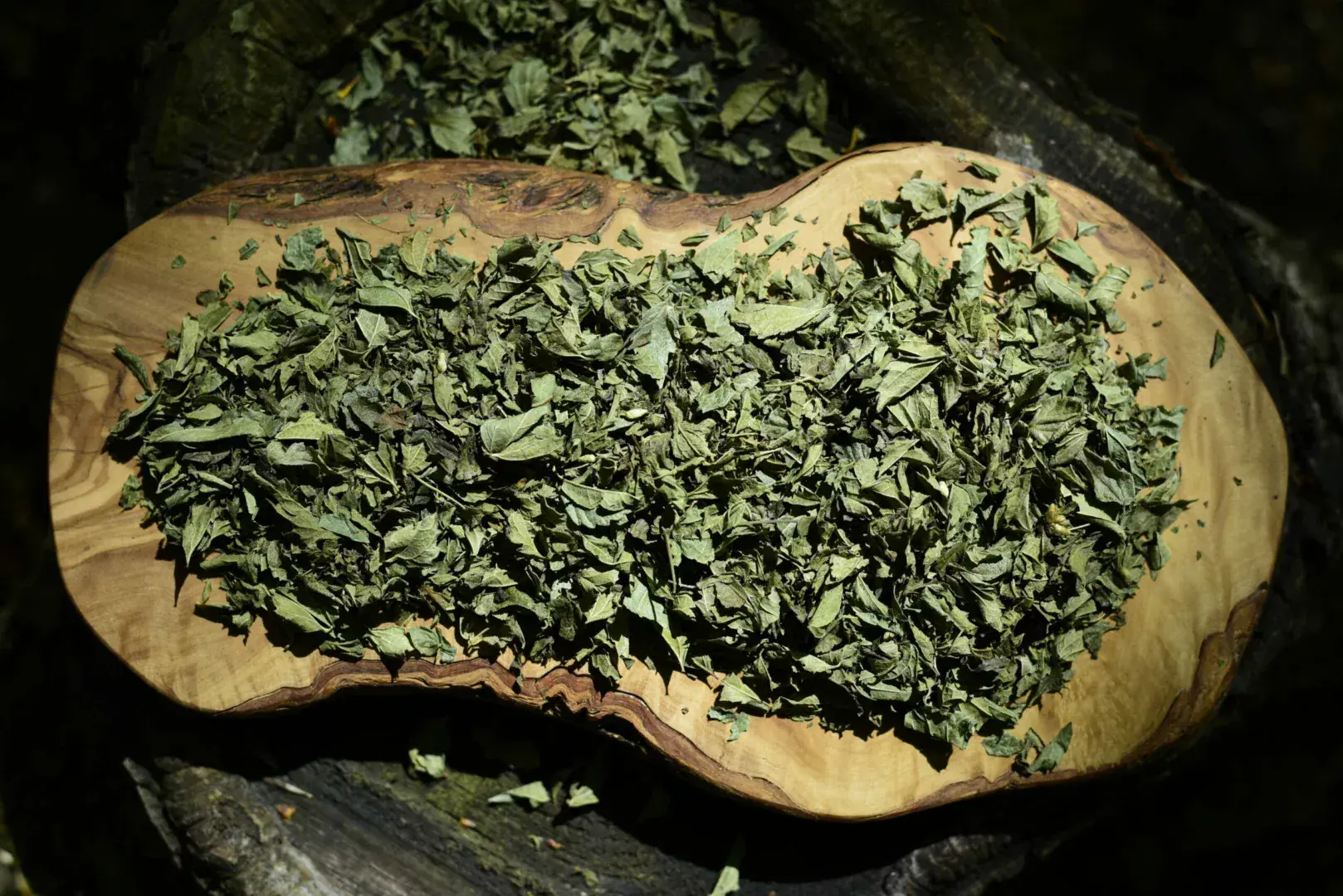
Here: whole wild-harvested leaves from the Puebla region of Mexico, from 10 to 200 g, shipped from France. Because Calea is easily confused with close species, we name her origin.
⊹ Chapter · Questions ⊹
Ask, answer, share.
One question, one answer — sometimes several voices. The community answers first; INFUSE steps in when it should.
Nobody has opened a thread yet about this plant. You can be the one — a real question, a use, a doubt, a detail.
Anonymous if you prefer.
In depthbotany · phytochemistry · history
For those who want to go below the page: botany, chemistry, then four voices, each one named. ◆ what the tradition left in writing, ◇ what research has measured, ● what our dreamers tell us, ☾ what the House says.
Botany and identification
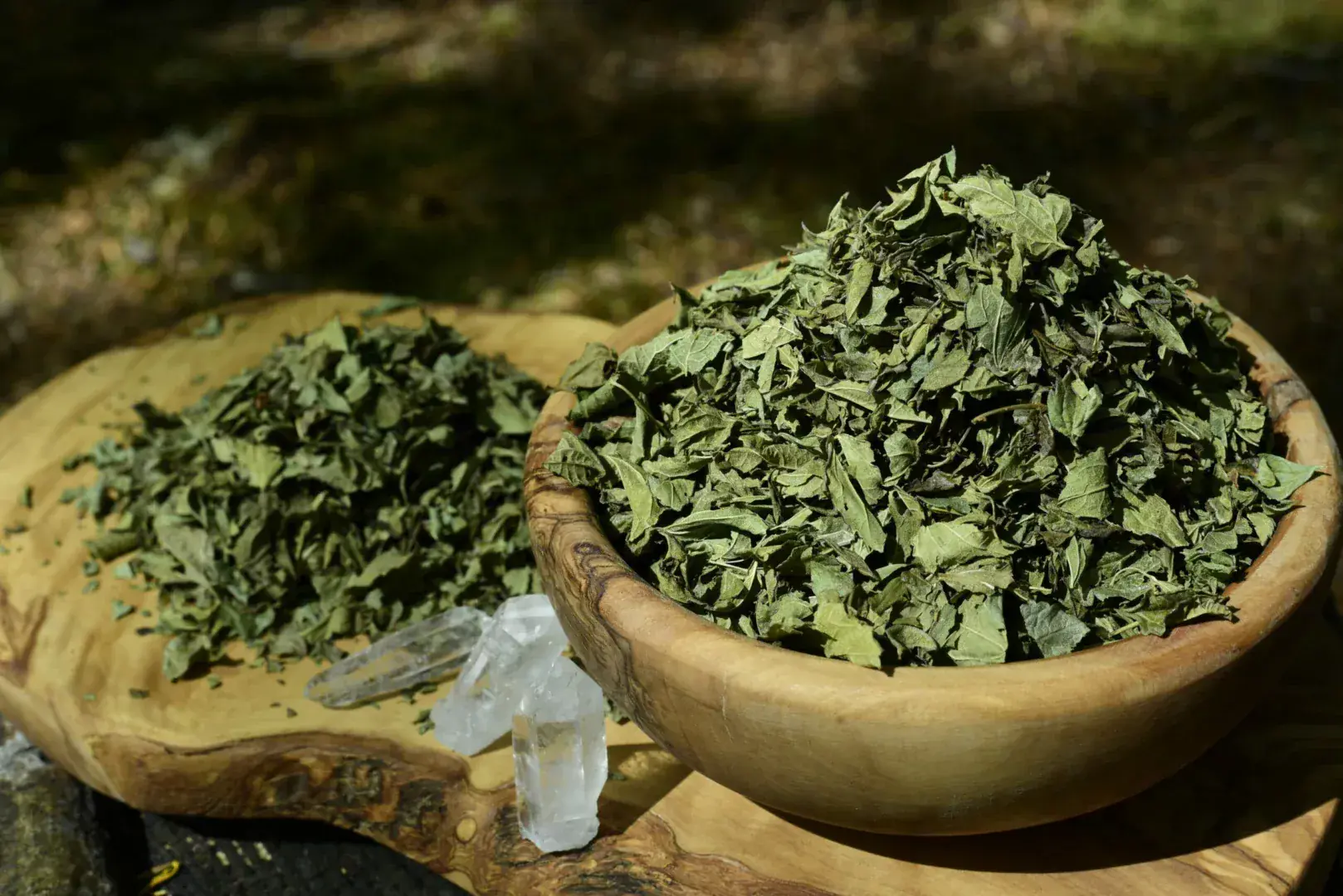
Calea ternifolia Kunth is the accepted name; Calea zacatechichi Schltdl., the name everyone searches for, is its synonym. She is an Asteraceae, of the chamomile and daisy family: a branched shrub about 1.5 m tall (rarely up to 3 m), with small oval leaves crisped at the edges and small yellow, sometimes whitish flowers. The underside of the young leaves turns violet, and the foliage is an intense green (Rätsch). She grows in Mexico and Central America.
Her identification is delicate: Calea is easily confused with close species of the same genus, and the trade sometimes sells another plant under her name. Hence the weight of a traceable supply. Ours comes from the Puebla region of Mexico, as whole wild-harvested leaves.
Phytochemistry: a plant that keeps her secret
No hallucinogenic constituent has been isolated from Calea (Schultes, Hofmann & Rätsch, Plants of the Gods, p. 38). She holds sesquiterpenes (caleicines, caleochromenes, germacranolides), chlorogenic acid and a flavone, acacetin. The germacranolides also help classify the species of the genus (Ferreira et al. 1980, cited by Rätsch). What acts on the dream, and how, remains unknown.
◆ The documented tradition
Among the Chontal of Oaxaca, in southern Mexico, the plant is called thle-pela-kano, "leaf of god". Healers take her to obtain messages during the dream: to find the cause of an illness, a distant person, a lost object (Mayagoitia, Díaz & Contreras 1986, after José Luis Díaz's fieldwork). For them, the plant "clarifies the senses" (Schultes, Hofmann & Rätsch, Plants of the Gods, 2001, p. 38). Christian Rätsch describes the bitter decoction of the curanderos and calls the practice oneiromancy; the fresh herb is sometimes slipped under the pillow (Encyclopedia of Psychoactive Plants, 2005, p. 117).
The gesture the books describe: drink the infusion, lie down in a dark room, sometimes smoke a cigarette of the leaves. The sign that the plant is working: you feel your pulse, the beating of your heart (Schultes, p. 79; Dale Pendell, Pharmako/Poeia, 1995, p. 115). The Chontal tell "good" plants from "bad" ones, and Díaz described chemical races, some of them inactive (Rätsch, p. 117; Pendell, p. 115).
The name zacatechichi comes from Nahuatl zacatl, "grass", and chichic, "bitter": the bitter herb. She is also called zacate de perro and, in English, Aztec dream grass (Rätsch; Schultes). This written memory comes from the ethnographic work of the 1960s and 1970s (Thomas MacDougall, then Díaz).
◇ The studies
One human study looks at dreaming: Mayagoitia, Díaz & Contreras (1986), Journal of Ethnopharmacology 18:229-243 (PubMed 3821139). In healthy volunteers, double-blind, Calea was compared with a placebo and with diazepam. During a controlled nap it increased light sleep and spontaneous awakenings, and dream reports were significantly more frequent than with the placebo and than with diazepam; the authors read this as hypnagogic imagery in light sleep. The volunteers also showed longer reaction times and a changed estimate of elapsed time. The abstract does not give the number of participants.
In animals: an antinociceptive effect in mice (Sałaga et al. 2016); anxiolytic-like and antidepressant-like effects in rodents, with more hippocampal gamma oscillations during REM sleep (Martínez-Mota et al. 2020). Toxicology gives signals worth knowing: in rats, lower platelets and white cells and higher liver enzymes (González-Yáñez et al. 2019); in cultured human kidney cells, cytotoxicity at low doses (Mossoba et al. 2016).
● Our dreamers
Of 269 reviews published on INFUSE, 40 tell of a night (read one by one in September 2026; a review can say several things): 22 speak of more vivid dreams, 10 of better recall, 6 of a lucid dream, 5 of better sleep, and 5 noticed nothing in their dreams. 16 of them mention the bitterness.
"That same night I had a lucid dream which was very insightful." — Neyda
"Personally I believe that it must be integrated with good preparation and predisposition for lucid dreaming. Alone it is not enough…" — Mauro
"it still has no effect in terms of dreams... terribly bitter taste, but from the 4th day you get used to it a little" — Cinzia
☾ The House
Our own words, from the very first page: "One of the greatest Master Plant Medicine for Dreaming, Calea Zacatechichi awakens the Dreamer inside of us. She is known to offer spectacular, vivid, memorable dreams at night, while enhancing our ability to self-reflect and journey within." We suggest a 3 to 5 day diet to know her fully, a teaspoon of leaves per cup, and breaks between cycles. As a tea she is very bitter; honey, lemon or mint help. In a smoking blend she stays a companion by day as well as by night. And what she opens, we wrote this way: "Calea Zacatechichi opens the door to discover the True Wishes of our Souls, whispering to us our reason to be here on Earth…"
Safety and legal status
Calea is an evening plant, kept for bedtime, with no driving or machinery afterwards. She is taken in cycles of a few nights, with breaks. Her bitterness can bring mild nausea at high strength; at high doses, the animal literature describes salivation, nausea and digestive discomfort. The toxicology signals above (blood, liver, kidney, in animals or cell cultures) are a reason to keep to small, spaced amounts. Allergy to Asteraceae (chamomile, echinacea, ragweed): take care. Pregnancy, breastfeeding, children: avoid, for lack of data. With sedative or psychotropic medication: ask your doctor first.
Freely sold in France and the European Union. Outside Europe, each country has its own law: check yours before ordering. This page documents a traditional dream use; Calea is not intended to diagnose, treat or prevent any disease.
Sources: Mayagoitia L., Díaz J.L., Contreras C.M. 1986, Journal of Ethnopharmacology 18:229-243 (PubMed 3821139) · Schultes R.E., Hofmann A., Rätsch C., Plants of the Gods (2001), pp. 38, 78-79 · Rätsch C., Encyclopedia of Psychoactive Plants (2005), pp. 116-118 · Pendell D., Pharmako/Poeia (1995), pp. 114-115 · Sałaga M. et al. 2016; Martínez-Mota L. et al. 2020; González-Yáñez M.G.E. et al. 2019; Mossoba M.E. et al. 2016. Reviews: INFUSE database, September 2026.