
Read it through your world
The whole page is read through this lens.
✦ Authentic Blue Lotus · in one breath ✦
Beyond waking, it offers conscious and lucid dreams — the elevated messages of the Soul.

⊹ The path of the plant
⊹ Community voices
What the community murmurs.
No testimony yet for this plant — nothing invented, nothing fabricated. If you have met it, your account can open the way for those who come after.
Ask the Forest about Authentic Blue Lotus
408 books digested, 97,512 indexed passages. She answers on lineages, synergies, cautions, ritual variations.
⊹ FREQUENT QUESTIONS ⊹
We answer.
What is blue lotus (Nymphaea caerulea)?
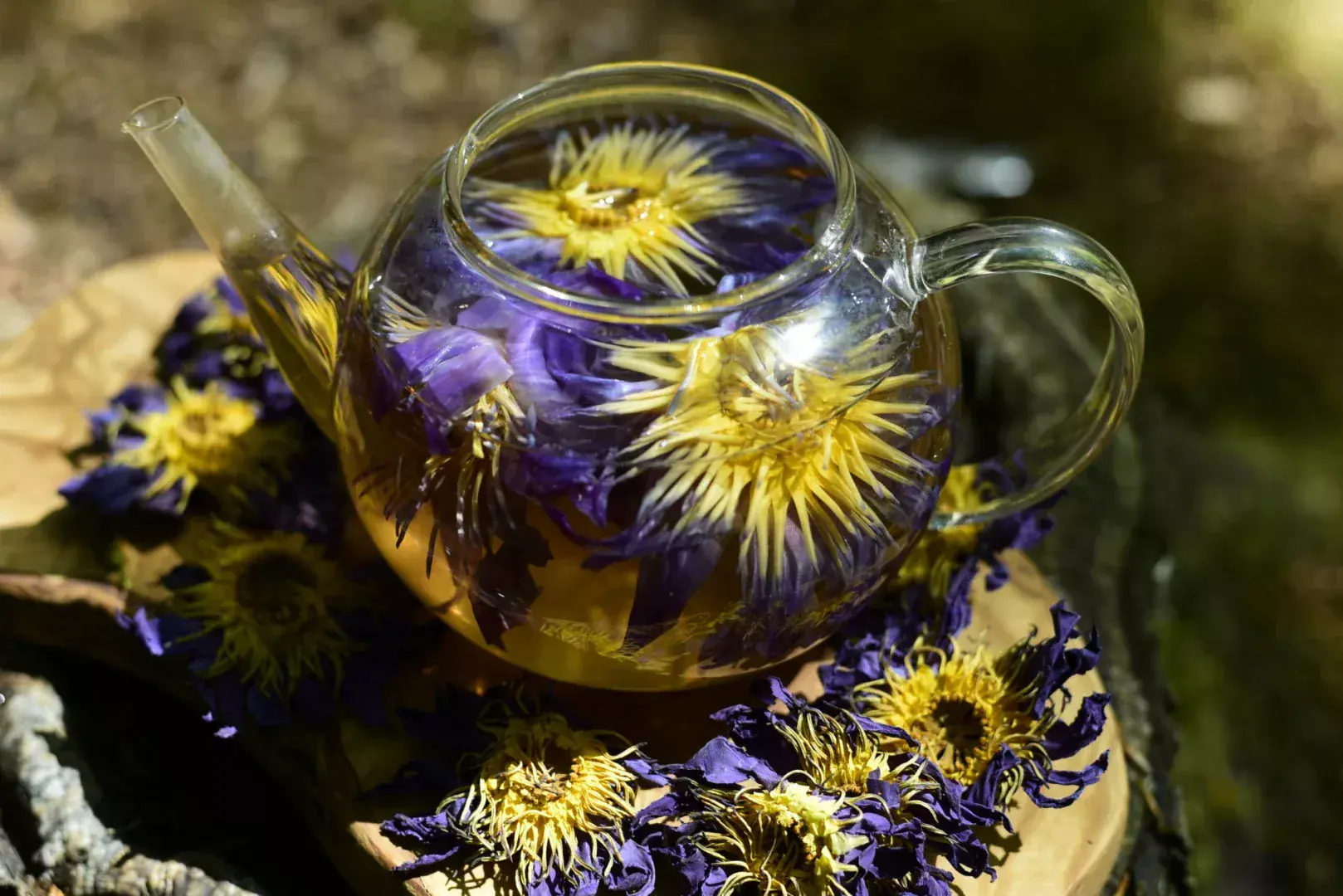
The Egyptian blue lotus is Nymphaea nouchali var. caerulea, long known as Nymphaea caerulea: a water lily of the Nymphaeaceae, sacred in ancient Egypt, where people read in her the course of the sun. Blue lotus petals adorned the floral collars in Tutankhamun's tomb. Botanically she is not the sacred Asian lotus (Nelumbo nucifera). She is drunk as a gentle evening infusion.
How do I know it is real Nymphaea caerulea?
By the flower: smaller, pale blue, dull white at the centre. Our flowers, wild-harvested in Sri Lanka, are set apart by eye by people who know the plant; no laboratory test guarantees it. The question is real: in 2023, none of eleven commercial 'blue lotus' products analysed matched the authentic extracts (Dosoky et al.).
What is the difference between the two blue lotuses, caerulea and nouchali?
Our common blue lotus, usually called Nymphaea caerulea, is in fact Nymphaea nouchali: a bigger, more fragrant flower. The authentic one, the caerulea variety, gives smaller flowers, far rarer and harder to harvest (four times more work for a kilo of dried flowers). Two sister flowers, both beautiful.
Is authentic blue lotus stronger than the common blue lotus?
Our two flowers have never been compared in a laboratory. By experience, we find her effects more refined, profound and magical; the common one, bigger and more fragrant, stays a wide and generous door. Choosing between them is choosing a density.
Are blue lotus and pink or white lotus the same plant?
No. Blue lotus is a water lily (genus Nymphaea); pink and white lotus are Nelumbo nucifera, the sacred Asian lotus, from another genus and family. INFUSE offers both.
How do I prepare a blue lotus infusion?
One flower in 250 ml of simmering, never boiling water (around 80 °C), 7 to 10 minutes, in the evening before sleep. The effect people describe rises slowly and stays gentle.
What is blue lotus elixir?
A tincture: the flowers of our authentic blue lotus macerated in an apple brandy, in a 30 ml bottle. From a few drops, to connect with the spirit of the flower, to two pipettes, a ceremonial or celebration dose, under the tongue or in a warm drink. One pipette for an immediate blast of Blue Lotus true magic.
What are the effects of blue lotus? Does she bring dreams?
The flower holds aporphines, nuciferine first among them; the presence of apomorphine is disputed. The strongest link to dreaming comes from archaeology: a Ptolemaic vase analysed in 2024 held blue lotus with Syrian rue, a mixture the museum's curator reads as a ritual of dream and vision. Among the Zulu, her flowers are sold for visions tied to the ancestors (Sobiecki 2008). Dreaming has yet to be studied in humans; our dreamers speak mostly of deeper sleep and more vivid dreams.
Is blue lotus legal in France?
Yes: freely sold in France and the European Union.
Where does INFUSE's authentic blue lotus come from?
From the lakes of Sri Lanka, wild-harvested with a small family business and set apart by eye. In South Asia the caerulea variety grows as an introduced plant: its native range is eastern Africa and southern Arabia.
What do people who tried blue lotus say?
This page has no reviews yet. Our common blue lotus, the sister flower, has 543 published reviews; 25 tell of a night: 12 better sleep, 12 more vivid dreams, 3 better recall, 3 meaningful dreams, 1 a lucid dream, 2 nothing in their dreams. Denisa: 'dream recall increased significantly !'
⊹ Chapter · Questions ⊹
Ask, answer, share.
One question, one answer — sometimes several voices. The community answers first; INFUSE steps in when it should.
- Voix anonymeSep 20
Combien de temps avant les premiers effets ?b
- flordelparaisoestelarINFUSE teamSep 25
La fleur des prêtresses n'est pas pressée. En infusion le soir, les premières sensations arrivent généralement dans les 30 à 60 minutes — une douceur qui s'installe, un léger relâchement, parfois une impression que le souffle se pose. L'élixir, pris sous la langue, peut être un peu plus rapide. Cela varie beaucoup d'une personne à l'autre, selon l'état du moment, le ventre vide ou non, la sensibilité propre. La fleur donne ce qu'on est prêt à recevoir — et parfois, la première fois, on ne perçoit qu'un murmure. Puis il y a les effets dans le monde onirique et au réveil et durant les heures qui suivent et là aussi cela varie d’une personne à l’autre et des circonstances 🙏🪷
In depthbotany · phytochemistry · history
For those who want to go below the page: botany, chemistry, then four voices, each one named. ◆ what the tradition left in writing, ◇ what research has measured, ● what our dreamers tell us, ☾ what the House says.
The plant: botany
The Egyptian blue lotus is Nymphaea nouchali var. caerulea (Savigny) Verdc., long known as Nymphaea caerulea Savigny, and also as Nymphaea capensis Thunb. It is a water lily, of the Nymphaeaceae. The sacred Asian lotus, pink and white, is Nelumbo nucifera, a different genus in a different family (Nelumbonaceae). Both are called "lotus"; they are two magnificent plants with no close kinship.
Schultes, Hofmann and Rätsch describe the flower as pale blue, dull white at the centre, with 14 to 20 lance-shaped petals and more than 50 stamens; the leaves are oval, peltate, irregularly toothed. Its rank is still discussed: a 2012 phylogenetic study places it closer to N. gracilis than to N. nouchali, so botanists debate whether it is a variety or a species of its own.
The variety's native range is the eastern half of Africa and southern Arabia, from Egypt down to South Africa, with Yemen and Oman. In South Asia it grows as an introduced plant. Our flowers are wild-harvested in the lakes of Sri Lanka, with a small family business, and set apart by eye by people who know the flower. The flowers are smaller, and a kilo of dried flowers takes about four times more work in the swamps than the common blue lotus.
Phytochemistry
The chemistry of the blue lotus is that of the aporphines. The best studied is nuciferine: in receptor tests it blocks the serotonin receptors 5-HT2A, 2B and 2C, partly activates the dopamine receptors D2 and D5, and activates 5-HT1A (Farrell et al. 2016). Apomorphine is often cited, but its presence is disputed: a 2023 analysis found none in six authentic extracts, with nuciferine only in traces (Dosoky et al., Molecules), while an earlier study detected it in two commercial products out of five (Poklis et al. 2017).
The same 2023 analysis compared eleven "blue lotus" products sold for perfumery with authentic extracts: none of them matched. They held synthetic fragrance and oils of citrus, lavender or geranium. The market is full of look-alikes, which is why we name our flowers with care.
◆ The documented tradition
The blue lotus is one of the most represented sacred plants of ancient Egypt. Water lilies appear on vases as early as the Protodynastic period, at Abydos and Hierakonpolis, and explicit commentary on them begins in the Fifth Dynasty, long before the New Kingdom tombs. The flower opens with the morning sun and closes toward evening, and the Egyptians read in it the course of the sun: death, and the return of light. Dale Pendell reports that it was sacred to Osiris (Pharmako/Gnosis). In the cosmogony of Heliopolis, a bud of blue lotus rises from the primordial waters of Nun, and from its heart comes Nefertem, god of the light of the first sun and of the scent of the lotus: a symbolic reading carried by the temple texts.
In Tutankhamun's tomb, discovered in November 1922, the botanist Percy Newberry identified petals of the blue lotus in several of the floral collars laid with the king; a wreath of olive leaves, blue lotus petals and cornflowers rested on the brow of the second coffin, opened in 1925. The botanist William Emboden (California State University, Northridge) first read the flower as a "sacred narcotic lily of the Nile" (Economic Botany, 1978), and later linked it to trance in dynastic Egypt (Journal of Psychoactive Drugs, 1989): a hypothesis, still debated.
The thread runs down to southern Africa. Among the Xhosa, the root of Nymphaea capensis, uzuba, an old name for this same variety, is counted among the ubulawu, the dream roots of the diviners; too coarse and astringent to drink, it is used for washing (Hirst 2005). In isiZulu the blue lotus is izibu: its dried flowers are sold in the muti markets of Johannesburg to bring visions tied to the ancestors (Sobiecki 2008, p. 345).
The organised ritual practice of the pharaohs disappeared centuries ago, and no living lineage carries that use today. We rely on archaeology and scholarship.
◇ The studies
In 2024, a team led by Davide Tanasi and Enrico Greco published in Scientific Reports the analysis of a Ptolemaic vase in the shape of the god Bes (2nd century BCE), kept at the Tampa Museum of Art (doi:10.1038/s41598-024-78721-8). Genetic sequences confirmed traces of Nymphaea nouchali var. caerulea, of Peganum harmala (Syrian rue) and of a Cleome, along with a fermented fruit liquid, honey or royal jelly, and human fluids. The museum's curator, Branko van Oppen, suggests the mixture may have served in a magical ritual inducing dream and vision, in the dangerous context of childbirth. It is the clearest link between the blue lotus and dreaming that archaeology has offered.
Dreaming itself has yet to be studied in humans. The nuciferine receptor tests are cited above (Farrell et al. 2016, doi:10.1371/journal.pone.0150602); the analysis of extracts and commercial products is Dosoky et al. 2023 (open access). A case series describes five soldiers (four who vaped an extract, one who drank it) with sedation and perceptual disturbances, all recovered with supportive care (Schimpf et al., Military Medicine, 2023, doi:10.1093/milmed/usab328).
This page records an archaeological fact and suggests no preparation combining blue lotus and Peganum harmala. Syrian rue contains MAO-inhibiting β-carbolines; outside expert hands the combination carries serious risks of interaction with many substances.
● Our dreamers
This page has no published reviews yet. Our common blue lotus (Nymphaea nouchali, the sister flower) has 543 reviews; 25 tell of a night (read one by one in September 2026; a review can say several things): 12 speak of better sleep, 12 of more vivid dreams, 3 of better recall, 3 of meaningful dreams, 1 of a lucid dream, and 2 noticed nothing in their dreams. These reviews are about the other flower.
"I drank the tea before going to sleep and I can attest it brings a sense of heightened awareness, calmness, peace and introspection. Also dream recall increased significantly !" — Denisa
"I noticed no effect on my dreams, but I don't really care much about that aspect, frankly - I was just looking for a natural sleeping aid." — Silvia
☾ The House
Our own words, when we first found her: "By experience, both are amazing mystical flowers. The Nymphaea x Nouchali offers bigger and more fragrant flowers; the authentic Nymphaea Caerulea offers smaller flowers and is a lot more rare and difficult to harvest due to the size of the flowers (needing 4x more work to get 1kg of dried flowers from the swamps) – and its effects are more refine[d], profound and magical." And of the flower herself: "Her power also reaches beyond the waking state, gifting Conscious & Lucid Dreams; elevated messages from our Soul through introspection, meditation, and sleep." "This magical flower gives you what you are ready to receive."
Safety and legal status
The blue lotus is a gentle plant, and a plant that acts on the mind all the same. The literature raises theoretical interactions with dopaminergic medication (aporphines act on these pathways), with MAO inhibitors and Peganum harmala, and with SSRIs; these are not clinically established, so check with a practitioner. Avoid during pregnancy and breastfeeding, as data are lacking. After use, avoid driving or operating machinery. A spaced evening gesture suits her better than daily use.
Freely sold in France and the European Union.
Sources: Schultes R.E., Hofmann A., Rätsch C., Plants of the Gods (pp. 49-50) · Pendell D., Pharmako/Gnosis (pp. 337-338) · Emboden W.A., "The sacred narcotic lily of the Nile: Nymphaea caerulea", Economic Botany 32:395-407 (1978), and "The sacred journey in dynastic Egypt", Journal of Psychoactive Drugs 21:61-75 (1989) · Tanasi D. et al., Scientific Reports 14:27891 (2024) · Dosoky N.S. et al., Molecules (2023) · Farrell M.S. et al., PLoS One 11:e0150602 (2016) · Schimpf M. et al., Military Medicine (2023) · Hirst M., Indo-Pacific Journal of Phenomenology 5(2) (2005) · Sobiecki J.F., Southern African Humanities 20 (2008), p. 345. Reviews: INFUSE database, September 2026.