⊹ To weave around
To accompany Aparajita
Click a card to see why it pairs — and choose your form.
⊹ Community voices
What the community murmurs.
5/557 reviews, including 55 left on our Etsy shop · 2 of them average 4.5/5
Wowzers! first time trying this flower as a tea and my oh my I feel amazing spiritually and mentally. such a beautiful tea to sip on while sitting in the Sun. also wanted to thank you for the free gifts they are always wonderful.
AfroYoYo
Amazing as always thank you I love this tea so much the colour the flavour the smell of the dried flowers are amazing. thank you.
AfroYoYo
Effective for relaxing, I really like it.
Arzeline Louis
Read Aparajita through your world
Tap a world and the whole page rewrites itself for it.
The page reads from the daylight side: the ordinary morning, the cup, nature that wants to help us.
✦ Aparajita · in one breath ✦
The poetic chemistry of the goddess Durga — the flower that changes destinies.
Signature INFUSEIntensity · scored out of 10
| creative everyday | 9/10 | |
|---|---|---|
| blue sacred feminine | 9/10 | |
| Medhya-mind | 8/10 | |
| blue bath | 10/10 | |
| poetic chemistry | 9/10 |
Register Aparajita the invincible, the flower that changes destiny, indigo blue that turns pink, Medhya category · Ayurveda — Medhya · Sri Lanka
⊹ The path of the plant
⊹ FREQUENT QUESTIONS ⊹
We answer.
What is butterfly pea flower (Aparajita)?
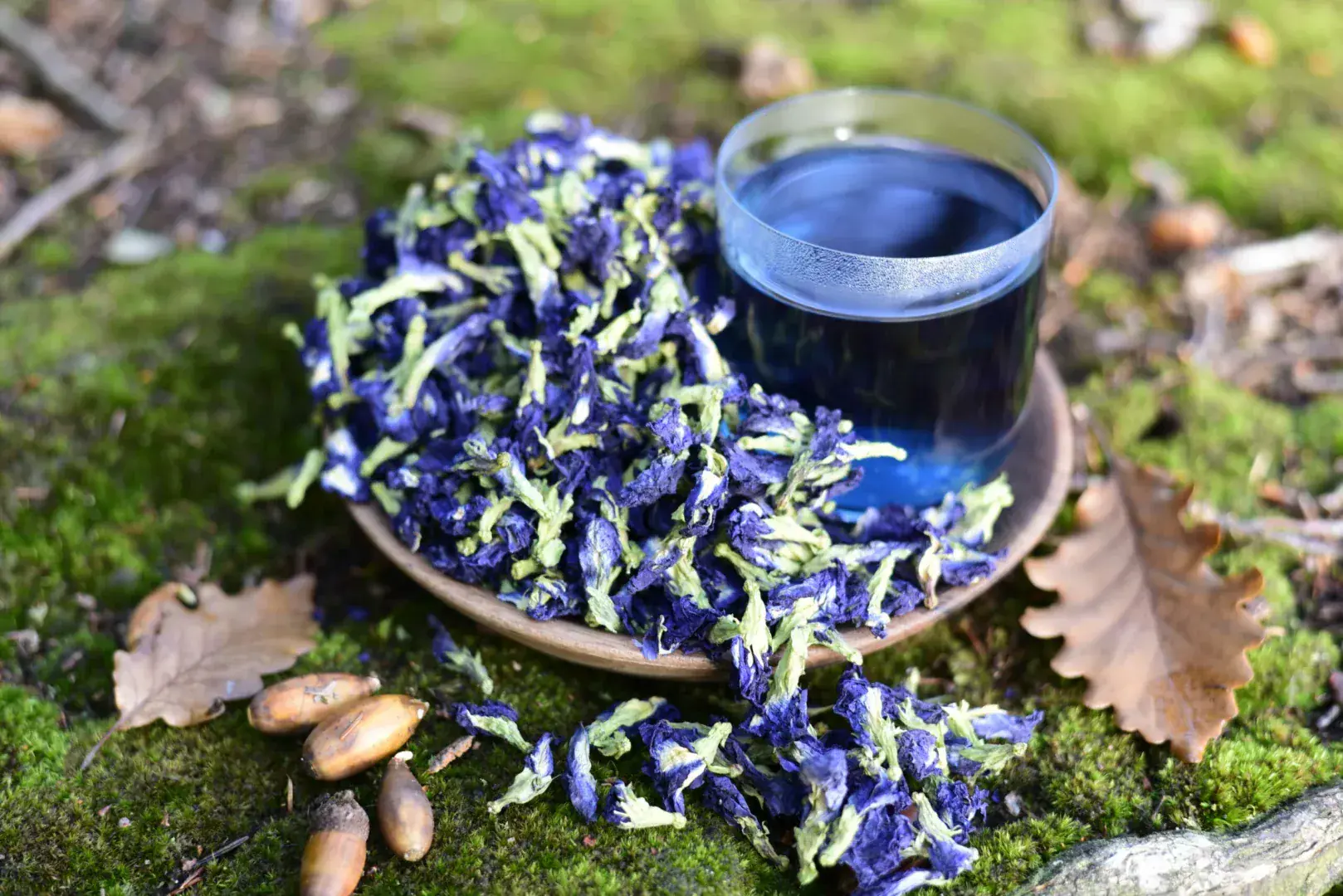
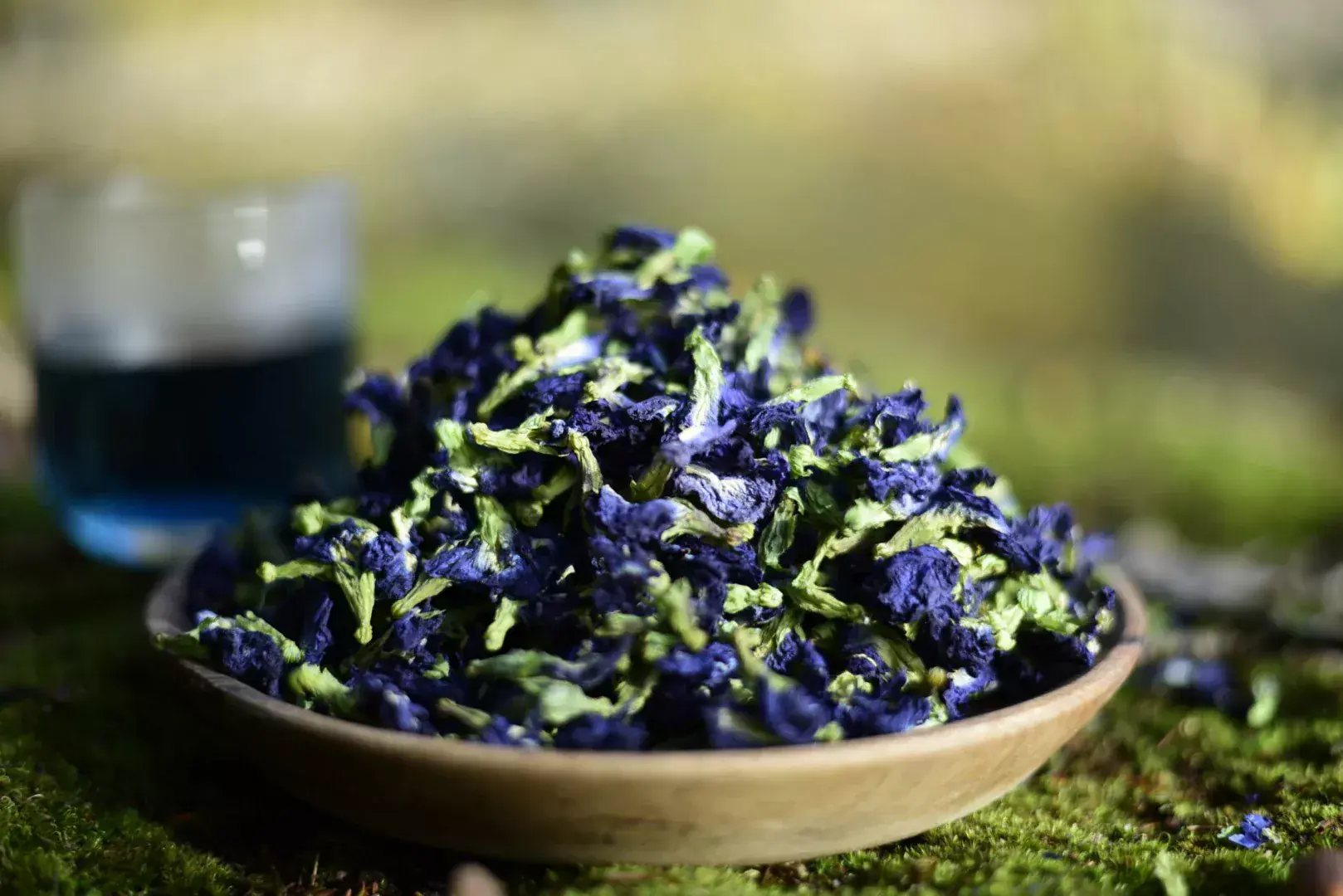
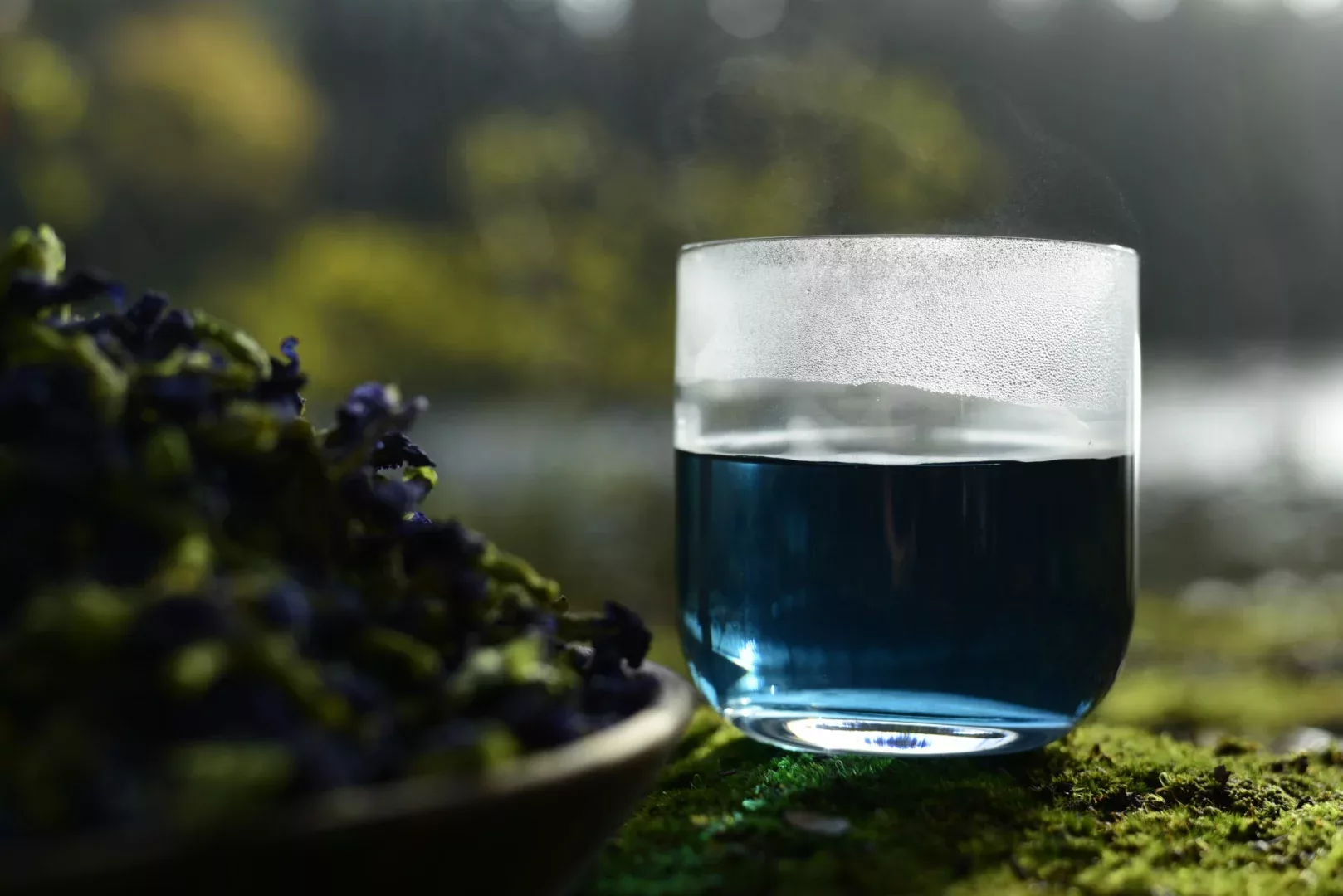
Butterfly pea flower is the indigo blue flower of Clitoria ternatea, a climbing liana from Southeast Asia. In India she is called Aparajita, the invincible. Infused in warm water, she releases a deep blue that turns pink as soon as lemon is added.
Butterfly pea flower, Clitoria ternatea, Aparajita: what are her names?
Her botanical name is Clitoria ternatea, a climbing liana of the pea family (Fabaceae). In English she is butterfly pea or blue pea; in India, Aparajita; in Thailand, anchan; in Malaysia, bunga telang. INFUSE sells the dried butterfly pea flower, wild-harvested in Sri Lanka, for colour, bathing and dyeing: in the European Union it is not authorised as a food.
What are the uses of butterfly pea flower?
In South-East Asia, she colours drinks, rice and pastries. In the European Union, where the dried flower is not authorised as a food, INFUSE offers her for colour: blue bath, dye, watercolour. Ayurveda ranks her among the Medhya, the plants traditionally dedicated to clear memory and intellect. Her signature remains beauty, colour and play.
How do you prepare a blue bath with butterfly pea flowers?
Stir a few spoonfuls of Aparajita powder into a bowl of hot water, then pour it into the bathwater: the indigo blue spreads. A dash of lemon turns it pink-violet. In Thailand, the same flower makes nam dok anchan, a blue tea with lemon; INFUSE sells it for non-food use.
Why does butterfly pea flower change colour?
Because of anthocyanins, pigments whose structure rearranges according to pH. In a neutral medium the flower is blue, in an acid one (lemon, vinegar) she turns pink, in a basic one (bicarbonate) turquoise green. The same water, three colours according to what you give it.
Can you drink butterfly pea flower tea in Europe?
In the European Union, the dried flower of Clitoria ternatea is not authorised as a food under Regulation (EU) 2015/2283 on novel foods. In 2022 EFSA raised safety objections linked to its cyclotides, and the European Commission closed the authorisation application on 12 February 2026. INFUSE therefore sells it for colour, bathing and dyeing.
All questions
Aparajita and Shankhpushpi: are they the same plant?
The name Shankhpushpi (conch-shaped flower) designates, according to Ayurvedic lineages, either Clitoria ternatea (Aparajita) or Convolvulus pluricaulis, two distinct plants. INFUSE works only with Clitoria ternatea, the blue flower. Verify the botanical identity before any purchase elsewhere.
Is butterfly pea flower suitable during pregnancy?
As a precaution, avoid it during pregnancy. If you are unsure, are breastfeeding or are taking anticoagulants, ask a healthcare professional for advice.
Where does INFUSE's Aparajita come from?
Our flowers come from Sri Lanka, wild-harvested by a small family business that also cultivates lotus and water lilies in vast marshes.
⊹ Chapter · Questions ⊹
Ask, answer, share.
One question, one answer — sometimes several voices. The community answers first; INFUSE steps in when it should.
Nobody has opened a thread yet about this plant. You can be the one — a real question, a use, a doubt, a detail.
In depthbotany · phytochemistry · historyRead
Botany
Clitoria ternatea is a perennial climbing vine of the Fabaceae family (legumes). The epithet ternatea refers to the island of Ternate, in the Moluccas (Indonesia), from where the species was described; today it grows throughout tropical Southeast Asia, India, Sri Lanka, the Caribbean and many warm regions. Its flowers have a corolla of deep indigo blue with a pale heart, whose shape recalls now a butterfly ("butterfly pea"), now a sacred conch ("Shankhpushpi"). It is also called blue pea or Asian pigeonwings in English, bunga telang in Malaysia and Indonesia, anchan (อัญชัน) in Thailand, and gokarna, "cow's ear", in Sanskrit texts, after the shape of the flower. All parts of the plant (roots, seeds, leaves, flowers) are used traditionally; the flower gives the blue.
Descriptive phytochemistry
The blue colour comes from six main anthocyanins, including the ternatins, acylated anthocyanins specific to Clitoria ternatea that give remarkable colour stability. Anthocyanins change structure with pH: blue in neutral conditions, pink-violet in acid, turquoise green in alkaline. The flower works as a living pH indicator. It also holds flavonoids (quercetin, kaempferol, myricetin), sterols (beta-sitosterol) and minor alkaloids.
Aparajita produces cyclotides, macrocyclic peptides of about thirty amino acids, folded into a "cyclic cystine knot" that makes them extraordinarily stable (resistant to heat, acid and proteases). Studied since the 1990s as pharmaceutical scaffolds and natural insecticides, they make this plant a subject of biotechnology research in its own right. Tradition named it invincible; chemistry finds exceptional stability in it, and the two forms of knowledge look at each other without contradiction.
What the studies report
Work on Aparajita remains largely preclinical (animal models). A 2003 study (Jain et al.) reports an anxiolytic effect in rats compared with diazepam, without the associated sedation: a laboratory result, neither a clinical promise nor a dosage. Other work describes acetylcholinesterase inhibition and a rise in hippocampal acetylcholine in rodents, a mechanism often associated with memory and learning, as well as antioxidant activity from the anthocyanins. INFUSE does not sell Aparajita as an anxiolytic: these data shed light on what tradition said, that the flower supports a mind that holds, without replacing it. If you have any questions about anxiety, sleep or cognition, consult a healthcare professional.
Lineage and long history
The name Aparajita places the flower within Durga's victory over chaos: the dharma that holds under pressure. It is offered in the three pujas (Durga, Saraswati, Shiva) as victory, wisdom and concentration. The conch signature (Shankhpushpi) links it to the primordial sound of Vishnu, to right speech, to the memory of the texts. Ayurveda places it among the Medhya Rasayana, the plants that nourish the substrate of thought.
Beyond India, the flower becomes cuisine and colour. In Kelantan, nasi kerabu, rice dyed blue, was a court dish: to eat blue was to eat under the signature of the sky. In Thailand, nam dok anchan is drunk cold at the markets; in Indonesia, the flower colours desserts and offerings (pewarna alami). One thesis runs through these tables: medicine and feast are one domain, and the beauty of the dish is part of the remedy.
A note of clarity: the Shankhpushpi confusion
The name Shankhpushpi refers, depending on the Ayurvedic lineage, to at least two different plants: Clitoria ternatea (Aparajita) and Convolvulus pluricaulis, with distinct profiles. Both are classed as Medhya Rasayana and carry the conch signature, but they are different plants. INFUSE works exclusively with Clitoria ternatea, the blue flower. Check the botanical identity before buying elsewhere.
Safety notes
In Southeast Asia, the flower colours drinks and dishes. In Europe, EFSA raised safety objections in 2022 to its use as an infusion, linked to its cyclotides: haemolytic and cytotoxic effects were observed in vitro for some of them, and their toxicological profile remains unknown. The European Commission closed the application for authorisation as a food on 12 February 2026. In the European Union, the dried flower of Clitoria ternatea is not authorised as a food, under Regulation (EU) 2015/2283 on novel foods. INFUSE sells it for non-food use: colour, bathing, dyeing. As a precaution: it is avoided during pregnancy (uterine-stimulating activity reported at high doses, not confirmed by a traced source); take care with anticoagulant treatment (slight antiplatelet effect reported) or blood-sugar-lowering treatment (theoretical additive effect). In a colour workshop with children, the blue water stays in the bowls and on the paper, for the wonder of it.
Read in the ForestThe articles that mention her.Read
⊹ Plants of Study