Read it through your world
The whole page is read through this lens.
✦ Ajo Sacha · in one breath ✦
It cleanses what no longer serves, protects, aligns and guides.
⊹ The path of the plant
⊹ Community voices
What the community murmurs.
Average · 75 reviews
Breakdown
on of three dieta plants that were used in my ayhuassca ceremony. I felt deep in love with this masculine plant, allowed me to let go of many things that held me down, be present, & plan for the future. amazing.
smiley
Ritual · 13 January 2023
I got interested in this plant because of its anti-micotic properties. I read people bathe in the infusion, so I considered rinsing with it - but I decided against it because I don't want to smell garlicky. So I drank it instead - it is nice and sweet, it smells kind of soup-y but n ot in an aggressive, Korean takeaway-like, way. It doesn't taste like garlic, but after 20 minutes or so, you can feel the flavor in your mouth and it persists for a couple hours. And after a few days, it seems to be working, because I'm not itching nearly as much!
Silvia Francesca
Ritual · 10 May 2021
Very good quality and energy. Thank you deeply I'm dealing with weird negative entities attached to my energy, creating havoc on my life. Ajo Sacha have me intuition to work on the physical body and the root chakra, which was exactly what I needed. Gratitude
Maria Gameiro
Ritual · verified purchase · 16 September 2025
Such a beautiful and powerful ally to have on hand, great for opening the heart with courage to fully feel. With many other benefits aside. Best Ajo Sacha tea I have tried, I won't go looking elsewhere for good quality Ajo Sacha, thanks for the experience
Daniel
Ritual · 4 May 2023
Wonderful. Very spiritually taught and antidepressant Can be my favorite herb or one of my favorite herbs as there are plenty of others that I love in this shop. Helps me a lot with mood disorders. Exceptional and unique taste
Nébuleuse
Ritual · 5 June 2021
Tres satisafait et aidé par la forme en resine, goutue, puissante et concentrée. Un allié précieux Par contre j''ai été déçu par les feuilles et les racines, surtout la deuxieme fois pour les racines qui n'avaient aucune saveur
Léo
Ritual · verified purchase · 11 July 2025
.. at the beginning a big headache, body tension then an intense clarity..
laurence
Ritual · 30 April 2023
Ajo Sacha is great and super powerful! Just a little difficult to consume the rasin from the paper as it gets very sticky.
Hannah Strandberg
Ritual · verified purchase · 23 January 2025
Beautiful herb that really smells like a wild garlic! Really easy to make a tea and my body really enjoys it
Kathleen
Ritual · 13 October 2023
I appreciate the wonderful selection of natural treasures in this store. The herbal medicine is of very good quality in my opinion and shipping is also smooth and fast. Thank you very much :). Next order already placed + doing another one in the next few days. And thank you also for those very nice samples !
Maik
Ritual · 13 February 2025
My order arrived quickly even though it crossed an ocean to get here. I exploring the subtle energies of this lovely plant vine.
Judith
Ritual · 21 February 2025
a well needed medicine in these times. enhances the missing masculine element is now found.
smiley
Ritual · 26 February 2023
Ask the Forest about Ajo Sacha
408 books digested, 97,512 indexed passages. She answers on lineages, synergies, cautions, ritual variations.
⊹ FREQUENT QUESTIONS ⊹
We answer.
What is Ajo Sacha?
Ajo Sacha (Mansoa alliacea) is an Amazonian liana of the Bignoniaceae family whose whole plant smells of garlic, with no botanical kinship to common garlic. Its name mixes Spanish ajo (garlic) and Quechua sacha (wild, of the forest). In the Peruvian Amazon it is a master plant, one that can be received alone in a dieta (Luna 1984).
Why does Ajo Sacha smell like garlic?
Because she synthesises the same sulphur compounds as common garlic — alliin and various allyl sulphides — through evolutionary convergence and not through kinship.
What are the traditional uses of Ajo Sacha?
Amazonian tradition uses it as a plant of purification, in a ritual bath before an important moment, and as a tonic for strength and vitality. The Shipibo take it in baths for luck in hunting, fishing and love (Rätsch & Müller-Ebeling 2013); hunters use it to mask their scent, fishermen to purify body, tools and canoe (Beyer 2009).
What is a master plant (planta maestra)?
In the Peruvian Amazon, a planta maestra is a teacher: a plant with its own personality, gifts and demands, learned through a dieta (a period of retreat). At the end of the dieta, it is said to pass on an icaro, a song received by the healer.
How is Ajo Sacha prepared?
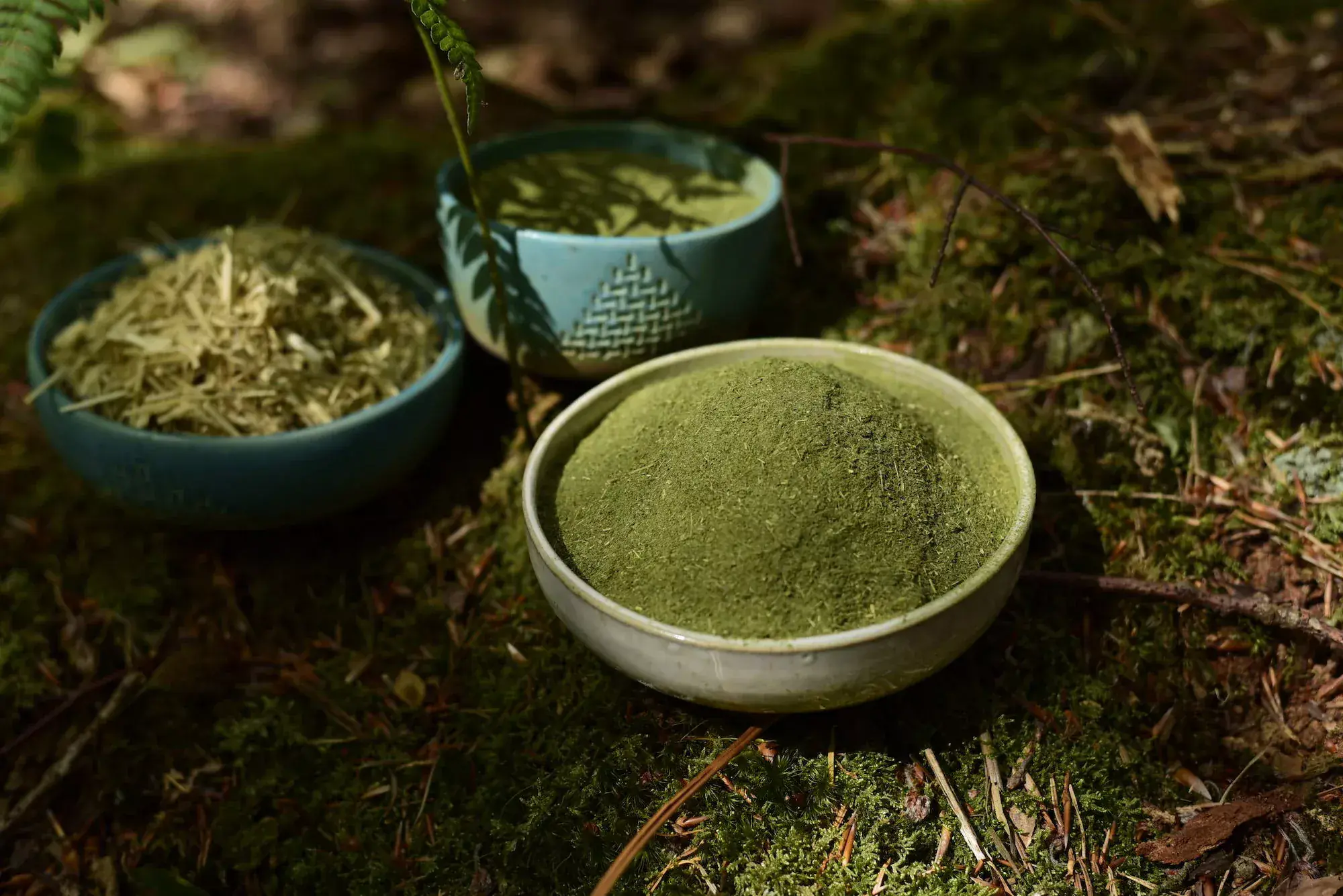
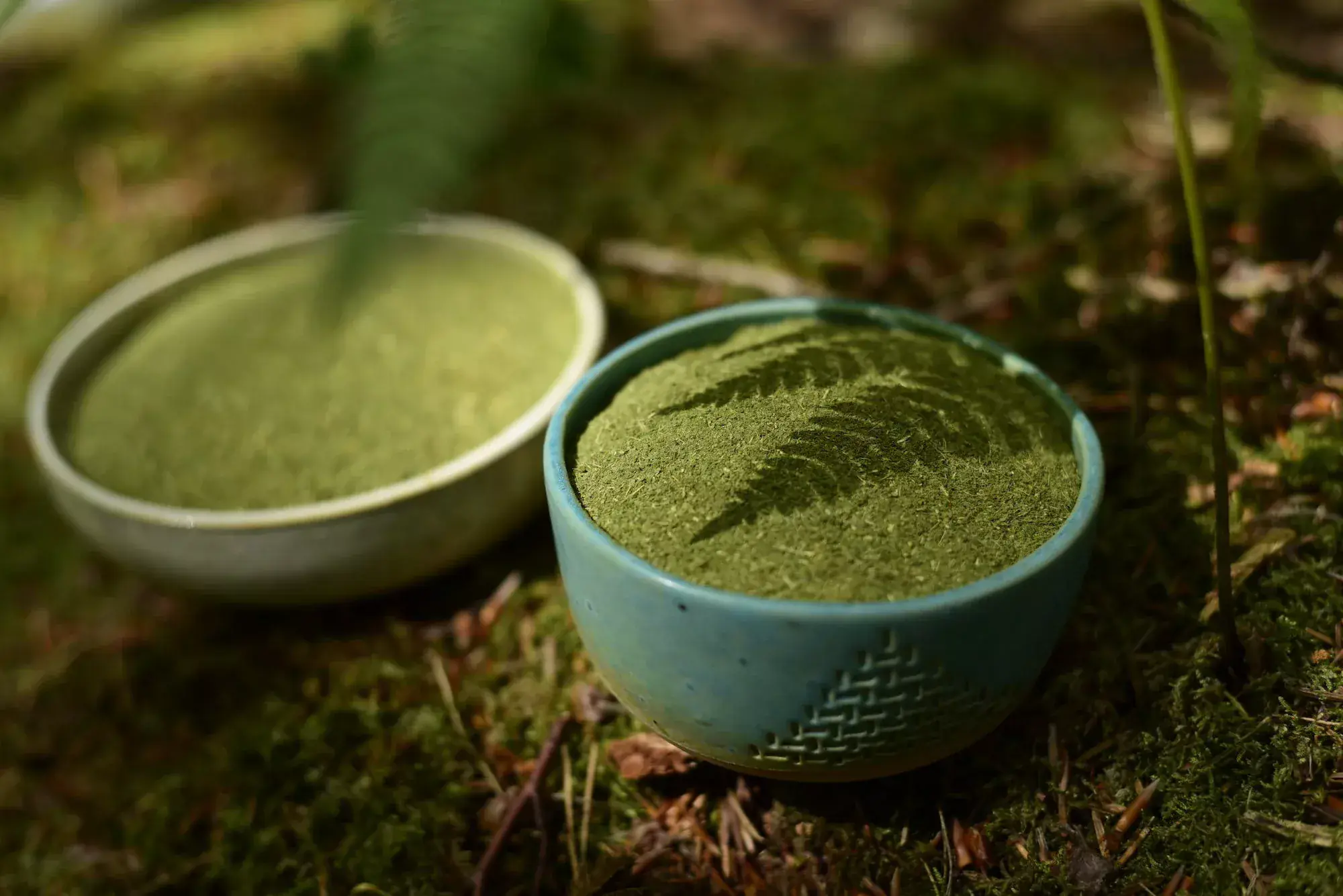
INFUSE offers three forms. The shredded vines are prepared as a long decoction of 20 to 30 minutes. The leaf powder is simply infused in a warm drink. The resin paste (x30 extract) dissolves under the tongue or in warm water. Tradition also takes her as a ritual bath, poured on the body without rinsing.
Does Ajo Sacha act on dreams?
Stephan Beyer, in Singing to the Plants, drawing on the vegetalista don Francisco Montes Shuña, describes her as a subtle ally who makes the dreams of the following nights particularly auditory — it is said that the plants begin to sing there. This is one of the reasons she is held as a source of icaros. INFUSE notably offers her in leaf powder for dream work.
Is Ajo Sacha legal in France?
Yes. Ajo Sacha (Mansoa alliacea) is not subject to any known legal restriction in France and in the European Union. She is sold freely as an ethnobotanical plant.
What precautions should I take with Ajo Sacha?
Like garlic, her sulphur compounds can reinforce the effect of anticoagulants and antidiabetic medications — hence caution, and stopping two weeks before a scheduled surgery. She is contraindicated as a principle during pregnancy and breastfeeding. In case of treatment, ask your doctor for advice before any cure.
What are the traditional benefits of Ajo Sacha?
Amazonian tradition holds her as a plant of cleansing and protection: a ritual bath (banho) before an important moment, a tonic for strength and vitality, a plant that helps clear the inner crossroads where a decision stalls. It is a use handed down by a living lineage, reported as tradition.
Where can I buy good-quality Ajo Sacha?
INFUSE imports Ajo Sacha from Peru, harvested on request so it stays fresh, in three forms — crushed vine, leaf powder, and resin extract — shipped to France, the EU and worldwide. The harvest is wild and respectful: our supplier commits to always replanting more than he takes, and works with a registered cooperative in Peru.
What are the spiritual benefits of Ajo Sacha?
For the vegetalistas, it is a master plant: it teaches the one who keeps its dieta, and its dreams are singularly auditory, the plants begin to sing (Beyer 2009). For the House, it is a protective spirit, like a father, who cleanses what no longer serves us and brings vivid dreams.
What is an Ajo Sacha dieta?
A period when the plant is taken every day, with plain food (no salt, sugar, fat or alcohol) and time in retreat, so that it can teach. Traditionally it is taken as a maceration of freshly grated root (Beyer 2009). At INFUSE we share it over 7 to 21 days, with a dream journal open.
What is the scientific name of Ajo Sacha?
Mansoa alliacea (Lam.) A.H. Gentry, of the Bignoniaceae family.
What do people who tried Ajo Sacha say?
Of 75 reviews published on INFUSE, only one speaks of its nights so far. Emily: 'great quality. insightful dreams, powerful herb.'
⊹ Chapter · Questions ⊹
Ask, answer, share.
One question, one answer — sometimes several voices. The community answers first; INFUSE steps in when it should.
- Voix anonymeSep 21
ajo sacha shredded vine or leaves powder?
- flordelparaisoestelarINFUSE teamSep 25
Depends on your intention : - Shredded vines: the traditional form for ritual work and dieta. Long decoction, 20 to 30 minutes simmering. Slower, more deliberate — the gesture itself is part of the practice. Leaf powder: simpler, faster. A teaspoon in a hot drink through a fine filter. Good for a daily or exploratory approach, before committing to the full vine. If you're drawn to Ajo Sacha as an opener — threshold work, ceremonial preparation — start with the vines. If you want to meet her first, more quietly, the powder is a gentler door 🙏🌿
In depthbotany · phytochemistry · history
For those who want to go below the page: botany, chemistry, then four voices, each one named. ◆ what the tradition left in writing, ◇ what research has measured, ● what our dreamers tell us, ☾ what the House says.
Botany: a vine that smells of garlic
Ajo sacha is Mansoa alliacea (Lam.) A.H. Gentry, formerly Pseudocalymma alliaceum; a recent revision of the Bignonieae places her in Adenocalymma, as A. alliaceum (Lam.) Miers. She belongs to the Bignoniaceae. A woody vine of the Amazon basin — Brazil, Peru, Bolivia, Ecuador, Colombia, the Guianas — she climbs trees at the forest edge and along the rivers, and bears clusters of tubular flowers, violet fading to white as they age. Christian Rätsch notes that she grows abundantly in places, notably along the Río Huallaga in Peru.
Her most striking trait is her scent. Crushed, the leaves, stem and bark smell clearly of garlic, sulphurous and slightly sharp. Hence her name, from Spanish ajo (garlic) and Quechua sacha (wild, of the forest): "wild garlic of the forest". She has no kinship with the garlic of Eurasia, Allium sativum; two unrelated lineages arrived at the same defensive chemistry.
Phytochemistry: what is named, what remains open
Her chemistry is still poorly mapped. Rätsch notes that the chemistry of the genus Mansoa is almost unknown, with alkaloids of undetermined structure. What the sources agree on are sulphur compounds close to those of garlic — alliin and several allyl sulphides (diallyl, divinyl and dimethyl disulphides and trisulphides) — which carry the smell. Stephan Beyer adds that none of these sulphur compounds is considered psychoactive. More recent pharmacognosy reviews also mention naphthoquinones (lapachones), iridoids, saponins, flavones and beta-sitosterol; these data remain to be consolidated.
Laboratory and animal studies report antimicrobial, anti-inflammatory, antifungal, larvicidal and antioxidant activity. These describe mechanisms seen in the lab and demonstrate nothing about clinical use in people. The effect at the heart of the tradition — on subtle perception and on dreams — has no isolated pharmacological correlate. It belongs to traditional knowledge.
◆ The documented tradition
A master plant of the Iquitos healers, one that can be taken alone in a dieta (Luna 1984). The vegetalista don Francisco Montes Shuña received it as a child: on the first night, he dreamt of a queen crowned with gold, with hands of branches, who told him not to be afraid; another night, she whistled him the melody of an icaro. He describes dreams that are singularly auditory, where the plants begin to sing (Beyer 2009, pp. 274-275). The Shipibo take it in baths for luck in hunting, fishing and love (Rätsch & Müller-Ebeling 2013, p. 61).
◇ The studies
Its garlic smell comes from sulphur compounds with no known psychoactive effect (Beyer 2009, p. 274). Its effect on dreaming is still to be studied.
● Our dreamers
Of 75 reviews published on INFUSE, only one speaks of its nights so far (read one by one in September 2026):
"great quality. insightful dreams, powerful herb." — Emily
☾ The House
Ajo Sacha is generally perceived as a masculine spirit, like a father, who guides us with full protection and strength. It is a potent Dream Master, inducing vivid dreams and leading us through an initiation to lucid dreaming.
A plant teacher that can be taken alone
In the Peruvian Amazon, ajo sacha is one of the *plantas maestras*, the plant teachers. The anthropologist Luis Eduardo Luna, working with four mestizo healers (vegetalistas) in Iquitos, lists her among these plants that teach the one who keeps their dieta, and notes that she can be taken on her own (Luna 1984, citing Encarnación 1983). A dieta is a time of withdrawal with a plain diet — no salt, sugar, fat or alcohol, no sexual contact — during which the plant is taken daily so that it can teach. She is also, at times, one of the plants added to ayahuasca preparations.
Stephan Beyer describes her as a "subtle ally" that shapes the dreams of the following nights and makes them "singularly auditory": in dreams, the plants begin to sing, which is why she is held to be a source of icaros. He tells the story of the vegetalista don Francisco Montes Shuña, who kept her dieta as a child: on the first night he dreamt of a queen crowned with gold, her hands made of branches, who told him not to be afraid; on another night she whistled him the melody of an icaro (Singing to the Plants, 2009, pp. 274-275).
Beyond the dieta, the most accessible use is the *banho, the ritual bath. In the mestizo practice of the upper Amazon, she is described as a "hot" plant, used against "cold" ailments such as rheumatic pains, and added to cleansing baths (limpia*) against fatigue, aches, and the saladera, a run of bad luck blamed on sorcery. Hunters drank her to mask their human scent, and fishermen washed their bodies, tools and canoes with her.
The words of the house
This is how we have spoken of her from the start:
"Ajo Sacha is generally perceived as a masculine spirit, like a father, who guides us with full protection and strength. This magical plant cleanses us of all that no longer serves us. A true treasure of positivity, Ajo Sacha welcomes everyone with open arms; uplifting our mood, anchoring us to the here and now. It is a potent Dream Master, inducing vivid dreams and leading us through an initiation to lucid dreaming."
The way we share her: *"Most efficient if consumed on a 'diet': from 7 to 21 consecutive days, to fully infuse in its medicine."* Once or twice a day, morning or evening; if only once, in the morning. And the invitation that goes with it: to call upon the spirit of the plant while preparing and drinking her, and to "pay attention to the shifts in your dreams and life aspirations".
Safety and landmarks
Ajo sacha is considered very safe at the amounts used in tradition. The main precaution comes from her garlic-like sulphur compounds: they may strengthen the effect of anticoagulants and antiplatelet drugs (warfarin, therapeutic-dose aspirin, clopidogrel) and of diabetes medication. If you take these, ask your doctor, and stop any cure two weeks before planned surgery. Avoid during pregnancy and breastfeeding, as data are lacking, and if you are allergic to Bignoniaceae. Tradition takes her in cycles: a cure of 7 to 21 days followed by a pause. She is freely sold in France and the European Union. This page documents a lineage and traditional uses; it is not medical advice, and if in doubt a health professional comes before the plant.
Sources: Luna L.E. 1984, Journal of Ethnopharmacology 11:135-156 · Beyer S., Singing to the Plants (2009, pp. 274-275) · Rätsch C., The Encyclopedia of Psychoactive Plants · INFUSE's own texts.
Sources for the four voices: Luna L.E. 1984, Journal of Ethnopharmacology 11:135-156 · Beyer S.V. 2009, Singing to the Plants, University of New Mexico Press, pp. 274-275 · Rätsch C. & Müller-Ebeling C. 2013, The Encyclopedia of Aphrodisiacs · our customers' reviews.