⊹ To weave around
To accompany Shilajit
Click a card to see why it pairs — and choose your form.
⊹ Community voices
What the community murmurs.
5/53 reviews, including 3 left on our Etsy shop
Quality, quick delivery,day by day I feel stronger ,one of a kind shop!Real staff,you can not buy anywhere else!Present is lovely too💯♥️♥️♥️THANKS
Anonymous
Thank you for your attention, top product!
Joëlle
I love the quality and feels very pure and organic.
Franci
✦ Shilajit · in one breath ✦
The rock juice of the high mountains: a half-organic, half-mineral resin, a grain in the hot morning drink.
Signature INFUSEIntensity · scored out of 10
| mineral grounding | 10/10 | |
|---|---|---|
| longevity rasayana | 9/10 | |
| mineral resin | 9/10 | |
| reinforced presence | 9/10 | |
| fasting morning | 9/10 |
Register Conqueror of Mountains, brag-zhun, mumijo of the Altai, black gold, wisdom of the mountains · Ayurvedic vaidyas · Tibetan monks · Siberian high-altitude shepherds
⊹ The path of the plant
⊹ FREQUENT QUESTIONS ⊹
We answer.
What is shilajit?
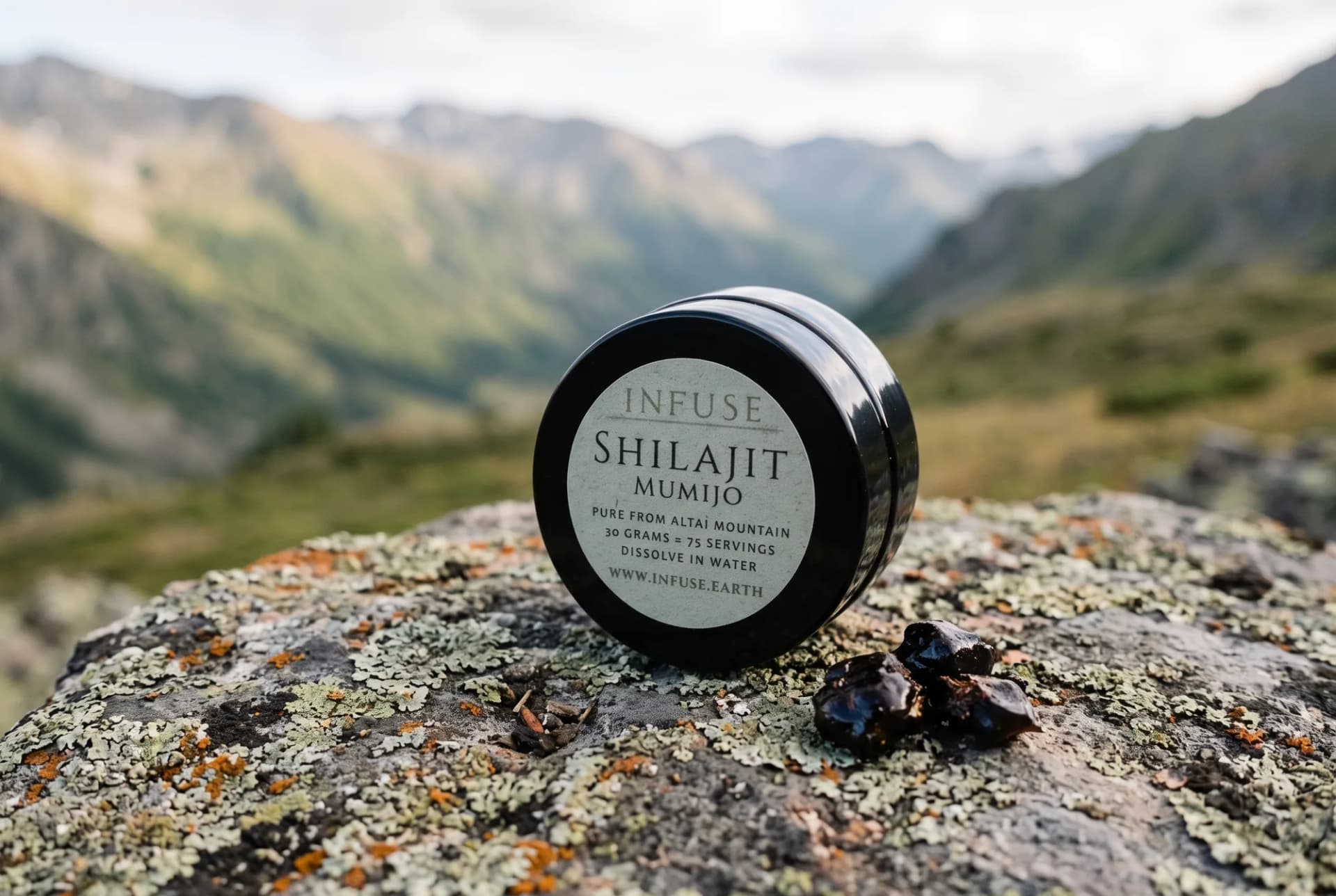
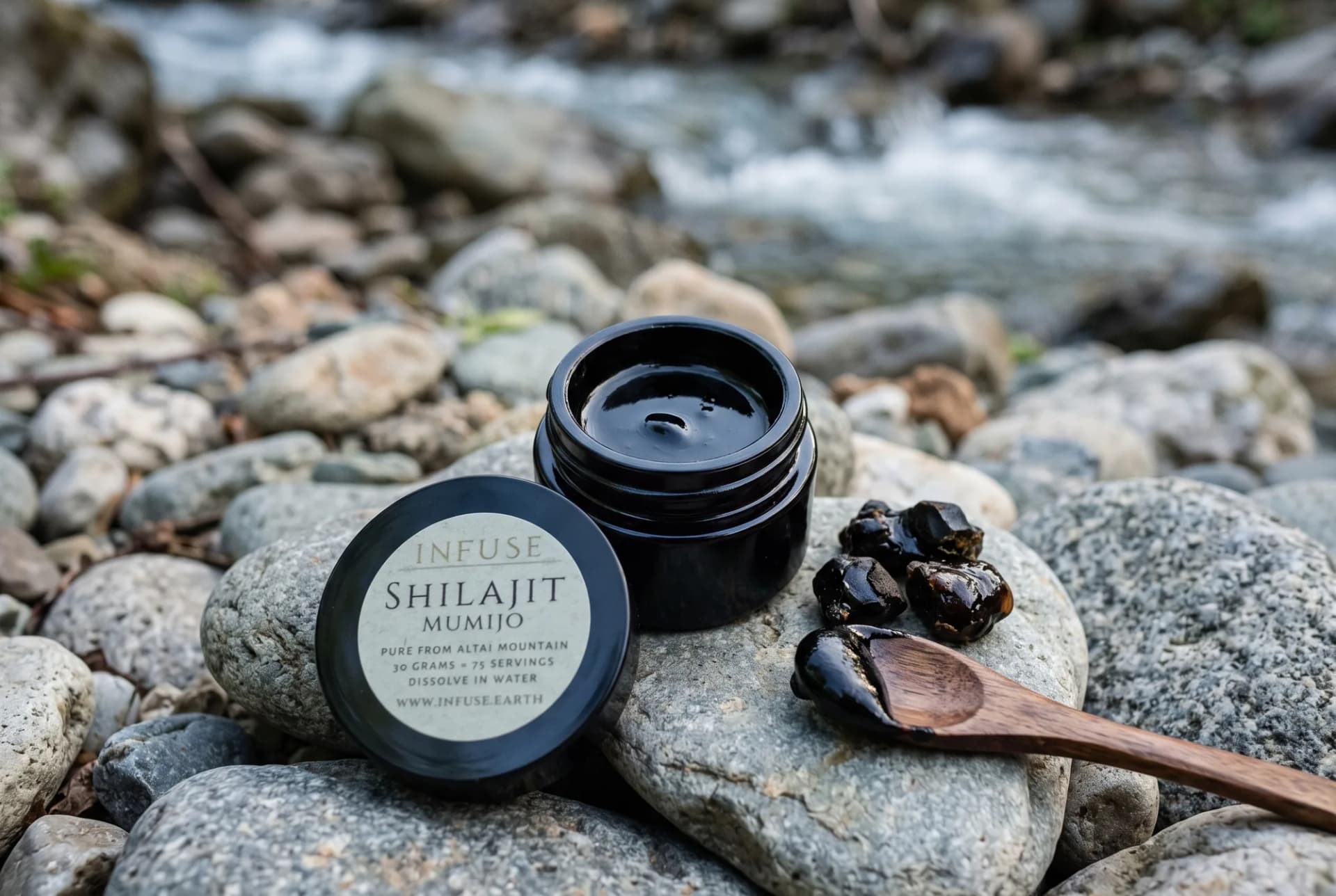
Shilajit is an organo-mineral resin that seeps from the fissures of high mountains, formed over centuries by the slow decomposition of alpine plants compressed in the rock. It is not a plant but a half-organic, half-mineral exudate, black and dense. INFUSE's comes from the Siberian Altai, where it is called mumijo.
What are the traditional benefits of shilajit?
In Ayurveda, shilajit is a rasayana medicine, that is to say of revitalisation and longevity, reputed toning and rejuvenating. The Charaka Samhita describes her as a substance that deeply reharmonises the body. Mountain traditions see her as a source of support for vitality, endurance and grounding. INFUSE reports these uses as tradition, never as a healing promise.
How do I use shilajit?
Take a tip the size of a small pea with a wooden or ceramic spatula (never metal), then dissolve her in a warm but not boiling water, a tea or a plant milk. Drink slowly, in the morning on an empty stomach. A little honey or ghee helps absorption.
How much shilajit per day?
A tip the size of a small pea, about 300 to 500 mg per day, is enough. If you are new to shilajit, start lower, around 200 to 300 mg, to observe your body's reaction. A 30 g jar lasts more than two months in daily use. Exceeding these benchmarks brings nothing and can cause discomfort.
How do I recognise pure shilajit?
Pure shilajit dissolves entirely in cold water, giving it a translucent amber-brown tint, without residue or particles. Gently heated, she softens like a living resin instead of hardening or burning inertly. Her taste is earthy, slightly bitter, deeply mineral. Above all, she must be purified and lab-analysed, because the raw resin can contain contaminants.
Does shilajit have contraindications?
Yes. Shilajit is contraindicated in people with haemochromatosis or iron overload (she contains iron) or gout (she can raise uric acid), and during pregnancy and breastfeeding and in children, owing to a lack of data. Caution applies with anticoagulant, diabetes or thyroid treatments. When in doubt, seek professional advice.
All questions
What time of day should I take shilajit?
Morning on an empty stomach is the traditional time, or before a sustained physical or mental effort. Avoid taking shilajit late in the day, as she can be stimulating in sensitive people. Ayurvedic tradition recommends courses of one to three months, interspersed with regular pauses.
Where does INFUSE's shilajit come from?
Our shilajit is wild-harvested in the Altai mountains, in Siberia, then purified and lab-analysed for heavy metals. She is packaged as pure paste, undiluted and unstandardised, in glass jars.
⊹ Chapter · Questions ⊹
Ask, answer, share.
One question, one answer — sometimes several voices. The community answers first; INFUSE steps in when it should.
Nobody has opened a thread yet about this plant. You can be the one — a real question, a use, a doubt, a detail.
In depthbotany · phytochemistry · historyRead
Botany and formation
Shilajit comes from the rock. David Winston lists it as having no botanical family (Family: None): it is a mineraloid, a black-brown substance (Asphaltum / bitumen) that exudes from rocks in the high mountains. It forms through the slow decomposition, over centuries or even millennia, of plant organic matter (mosses, lichens, alpine plants) trapped between rock layers, under the pressure of glaciers and the cyclical play of frost and heat. The result is a half-organic, half-mineral complex, which each mountain range (Altai, Himalaya, Karakoram, Pamir, Caucasus) signs with its own mineral composition.
Descriptive phytochemistry
The mass of shilajit is 60-80% humic compounds: fulvic acid and humic acid. Added to these are dibenzo-alpha-pyrones (DBP), characteristic antioxidants, and a range of more than twenty mineral elements in ionic form (calcium, magnesium, sodium, potassium, iron, chromium, zinc, copper, manganese, selenium), along with triterpenes, sterols, ellagic acid, 3,4-benzocoumarins, polyphenols and phenolic lipids. In taste, Winston describes it as bitter, slightly pungent, salty and hot, with a marked earthy smell.
What the studies report
Modern research on shilajit is growing but remains limited compared with better-studied adaptogens. A randomised double-blind clinical trial (Pandit et al., Andrologia, 2016) reports, in men aged 45 to 55 receiving 250 mg twice a day for 90 days, a rise in total testosterone, free testosterone and DHEAS compared with placebo; another study reports an increase of about 23.5% in infertile men receiving 200 mg/day of purified shilajit. Other work describes fulvic acid and DBP as a phytocomplex with procognitive activity (Carrasco-Gallardo et al., 2012), and adaptogenic or hepatoprotective effects are observed in preclinical models. These data describe observations, not promises: many traditional uses attributed to shilajit remain to be explored clinically.
Long lineage
The Rig Veda evokes soma, a mythical substance that "has the mountains and stones for a body"; Winston links shilajit to it, the elixir of immortality of the alchemists. The Charaka Samhita gives it the famous formula: it "cures every curable disease, taken with the proper vehicles (anupanas)". INFUSE cites these words as tradition, never as a health claim. The Ayurvedic legend of King Chandra Varma tells of an ageing sovereign who, withdrawn to the Himalaya, receives from Shiva a substance of revival: shilajit. A poetic variant makes it the tears of Shiva fallen on the rock and hardened by the centuries. Finally, an origin story recounts how villagers, watching great white monkeys chew the resin seeping from the rocks in summer and crediting it with their strength and longevity, began to consume it: an illustration of a principle of ethnopharmacology, that people have often learned by watching animals.
The four colours
The Ayurvedic tradition distinguishes four varieties by colour, aligned with the four metals: Sauvarna (gold, solar), Rajat (silver, lunar), Tamra (copper, Venusian), Lauh (black iron, Martial). This grid of correspondences guided classical prescription. Today, the vast majority of commercial shilajit is of the Lauh type, the most common.
Purification and authenticity
A crucial point: raw shilajit can contain heavy metals, mycotoxins and soil debris. Consuming it unpurified can be dangerous. The Ayurvedic and Tibetan traditions developed purification protocols lasting several weeks: dissolving in spring water, successive filtrations, sometimes triple distillation and sun-drying. Three traditional tests offer an initial point of reference at home: cold water (complete dissolution, translucent amber tint), heat (true resin softens instead of hardening or burning), taste (earthy, bitter, mineral). But the only reliable guarantee remains the laboratory test for heavy metals on each batch.
Safety notes
Shilajit is a powerful substance of ancient tradition. It is contraindicated in people with haemochromatosis or iron overload (iron content), should be used with caution by people with gout (possible rise in uric acid), and should be avoided during pregnancy and breastfeeding and by children, owing to a lack of data. Interactions are possible with anticoagulants, diabetes and thyroid treatments, and iron supplements. Modest doses, verified quality, listening to the body.